
Merck and Co’s cancer drug Keytruda to smash sales records by 2023 – forecast

Merck & Co’s Keytruda cancer immunotherapy is set to become the world’s top-selling drug by annual revenue in 2023, smashing sales records set by AbbVie’s inflammatory disease drug Humira, according to a new forecast.

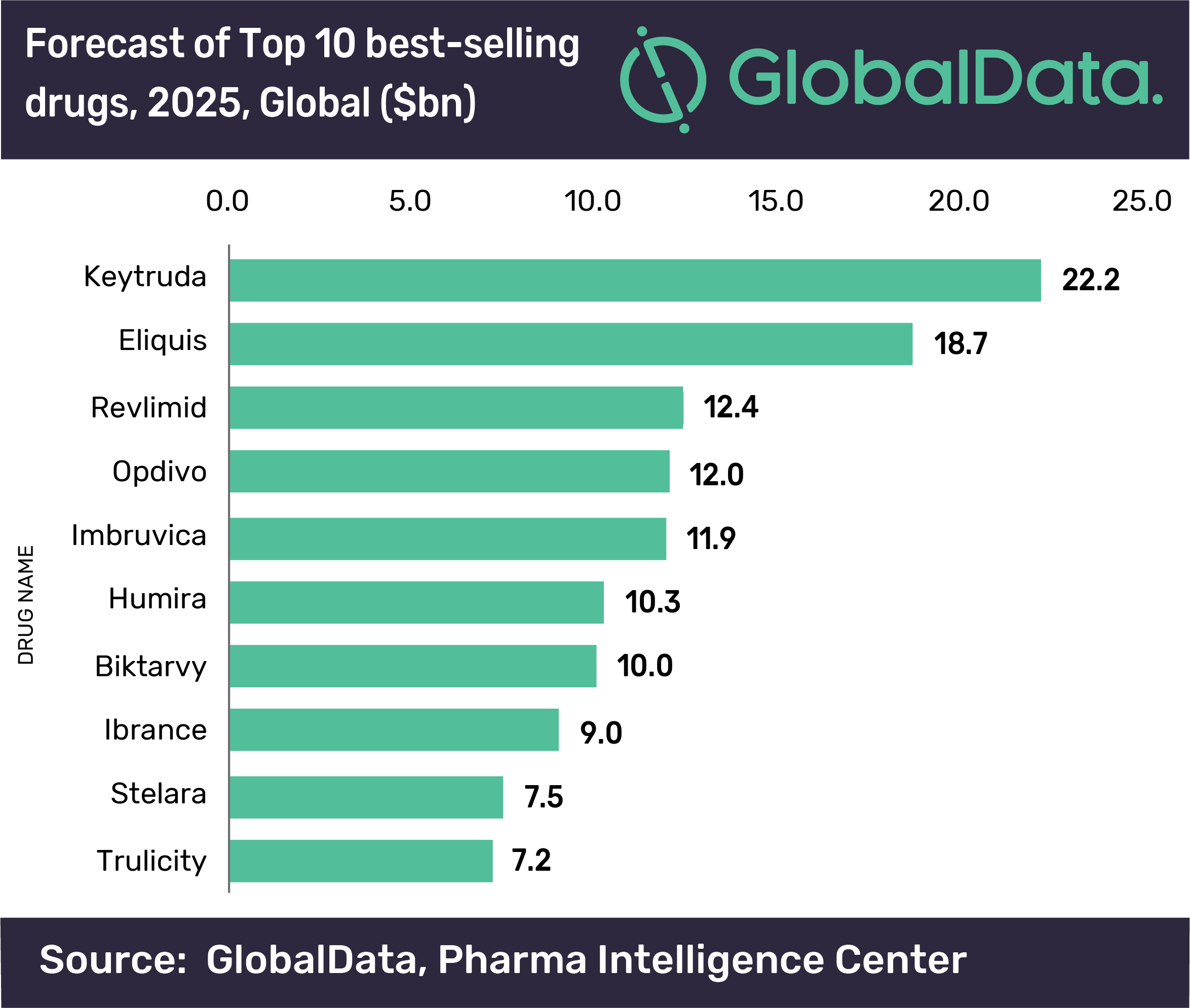
According to the forecast from GlobalData, PD-1 class Keytruda (pembrolizumab) will earn US-based Merck & Co and Otsuka Holdings more than $22.2 billion by 2025.

Followed by Keytruda, Bristol-Myers Squibb and Pfizer’s Eliquis (apixaban) the novel oral anticoagulant will be the second best selling drug in the top 10, with annual sales of $18.7 billion by 2025 according to the forecast by GlobalData.Top_10_2025
The figures mean that Keytruda will break sales records set last year by AbbVie’s Humira (adalimumab) inflammatory diseases drug, which peaked at just under $20 billion annually but is now being affected by patent expiries outside the US.

Like Humira, which has multiple inflammatory disease indications, Keytruda’s strength is in its versatility, as it has been approved for more than 20 oncology uses in the US, with many more likely to follow, as well as in new combinations with other drugs.

By 2025, Humira will have dropped down the list of 10 best selling drugs, following patent expiry in the US in 2023 when a gang of cheaper biosimilar rivals are set to hit the market.

According to GlobalData, Keytruda’s rival from Bristol-Myers Squibb, Opdivo (nivolumab) will be the fourth largest drug with annual sales of $12 billion, slightly behind Celgene’s Revlimid (lenalidomide) in third place on the list with $12.4 billion.

J&J and AbbVie’s Imbruvica (ibrutinib) comes in at fifth place in the forecast with sales of $11.9 billion.

Humira comes next with sales of $10.3 billion, followed by Gilead’s HIV drug Biktarvy ($10 bn), Pfizer’s breast cancer drug Ibrance ($9 billion), Johnson & Johnson’s Stelara for inflammatory diseases ($7.5 billion), with Eli Lilly’s Trulicity in tenth place with annual sales of $7.2 billion.


Flawed trials supported half of recent approvals of cancer drugs in Europe, study says

As drug makers race to bring cancer treatments to market, a new study finds about half of the supporting clinical trials for cancer medicines recently approved in Europe had a high risk of bias, underscoring concerns about approval standards and exaggerated benefits for patients.

PL_PILLS-768x432

Half of all cancer drugs approved by the European Medicines Agency (EMA) from 2014 to 2016 were the result of trials that exhibited a high risk of bias and even exaggerated treatment effects, a new research study says.

Researchers at seven institutions in the U.S. and UK examined data from 39 studies resulting in EMA approvals following concern that new drug submissions in Europe lack enough scientific evidence to support approval. According to the study, risk of bias was seen in 19 of the oncology drug trials — in 10 trials owing to missing outcome data and seven due to the way outcomes were measured.

The study was tasked with examining the design characteristics, risk of bias and reporting adequacy of trials of oncology drugs approved by EMA in the three-year period. Oncology is the single largest category of drug approval in the EU. More than one-quarter of EMA approvals in 2017 were for cancer drugs.

Randomized control trials (RCT) comprised 76 percent of the study sample. Only seven approvals were supported by two or more RCTs. Researchers found an increasing percentage of cancer drugs are approved based on findings from non-randomized or single-arm trials, which made up 24 percent of the study sample.

Of the RCTs, 23 trials demonstrated deviations from intended interventions due to either lack of blinding or risk of compromised blinding.

Researchers found that trials evaluating overall survival were at lower risk of bias than those that evaluated other endpoints, such as surrogate measures of clinical benefit for cancer patients. However, overall survival, or the length of time from either the date of diagnosis or start of disease treatment to present, was used as a primary endpoint in only 26 percent of trials.

Other trials evaluated indirect measures of clinical benefit, such as disease response, event-free survival or safety endpoints, which are not always a reliable predictor of whether a patient will live longer and have a better quality of life.

Researchers also identified 10 trials with concerns resulting from inappropriate comparators and non-preferred study endpoints.

Findings of bias differed, the study said, between trials relying on information available from scientific literature as opposed to regulatory documents, such as European Public Assessment Reports (EPAR), indicating that the information being communicated by these different sources is being interpreted differently by sponsors and can result in confusion and misconception.

For example, researchers found in the case of one study, that scientific literature was missing some outcomes data, but the related EPAR provided more information about study and treatment discontinuations. Taken together, the two sources provided a more accurate picture of study results.

“Because cancer drugs are responsible for most of the recent increases in pharmaceutical spending,” the study concludes, “the evidence base that supports their market entry warrants close scrutiny.”

Read the full report here: https://bit.ly/2mjr2qT.

By Colin Stoecker

Compensation for medical device side effects soon

Recommendation by panel to be sent to health minister for inclusion in Drugs & Cosmetics Act


ned
Indian manufacturers and importers of medical devices will soon have to compensate patients for serious side effects of their products. On Wednesday, an experts’ panel set up by the government finalised the terms of a legally binding compensation formula which will be recommended to the health ministry for incorporation in the Drugs and Cosmetics (D&C) Act, people aware of the matter told ET.

India so far did not have legal provisions to compensate patients who suffer serious side effects due to use of medical devices. The law mandates compensation only when something goes wrong during a clinical trial.

According to the formula finalised by the nine-member medical devices sub-committee, compensation will be determined on the basis of parameters like the base amount, loss of wages, and the degree of disability, the persons cited earlier said, requesting not to be named. The panel is headed by former director general of health services (DGHS), BD Athani.

“If the disability is higher, permanent and the patient is young, the compensation is higher,” said one of the persons cited earlier.

The experts have suggested a composition of “causality assessment committee” to determine if the adverse event happened due to the manufacturing defect of the medical device or otherwise.

In case of imported devices, the liability to pay compensation will fall on the Indian agent licensed to sell the product. Once the formula is approved and notified by the government, all devices regulated under the Drugs and Cosmetics Act will fall under the ambit of the amended legislation.

The proposal to chalk out a formula for compensation in case of medical devices was part of the government’s 100-day agenda. The sub-committee was formed after investigations were started into problems due to hip implants manufactured by a subsidiary of Johnson & Johnson (J&J) which required some patients to undergo revision surgery. While some of the affected patients received compensation this year after court intervention, the gap in the law prodded the government to put in place a structure for future compensations.

Before finalising their recommendation, the experts’ committee had examined the terms of the Motor Vehicles Act, the compensation formula used for awarding subjects who suffer injury in medical clinical trials, the formula prescribed for patients who suffered in the Johnson & Johnson hip implant case, among others.

The expert committee consists of representatives of Indian and multi-national device makers along with state drug controllers and public health experts. “The manufacturers who are part of the committee have come to the conclusion that the patient should be entitled to a decent compensation in case any untoward incident happens. However, cases of medical negligence by doctors will not be covered under this formula,” the person quoted earlier said.

Among other suggestions, the panel has said that state-level expert committees should be formed to investigate compensation claims

MHRA says Avastin can be used for AMD, despite Bayer, Novartis objections

The UK drugs regulator has endorsed the use of Roche’s Avastin as a treatment for age-related macular degeneration, a leading cause of blindness, even though it isn’t approved for that use.

iStock_74830495_MEDIUM-1-605x340

The Medicines and Healthcare products Regulatory Agency (MHRA) looked into off-label use of Avastin (bevacizumab) for AMD in the context of an ongoing judicial reviewrequested by Bayer and Novartis, which sell authorised AMD drugs and have long-argued that Roche’s drug shouldn’t be used in this way.

The MHRA’s statement comes down on the side of 12 NHS Clinical Commissioning Groups which have implemented a policy of using diluted and repackaged Avastin as a low-cost alternative to the two approved treatments – Bayer’s Eylea (aflibercept) and Novartis’ Lucentis (ranibizumab).

All three drugs are VEGF inhibitors, blocking the growth of abnormal blood vessels in the back of the eye that are responsible for the progressive loss of vision in the wet form of AMD, but Avastin is approved only for cancer indications.

In its judgment, the MHRA has determined the process of compounding Avastin to produce multiple doses, usually in plastic syringes, doesn’t exceed what is allowed for off-label use of a drug as the medicines regulatory regime “does not legislate how medicines are to be prescribed and used by healthcare professionals once they have been placed on the market.”

Avastin costs around £28 per injection when used off-label as an intravitreal injection for AMD, which compares to a cost of £816 for Eylea and £551 for Lucentis, according to the judicial review documents.

The MHRA does note that if Avastin were to be made available in single-dose syringes intended for AMD treatment they would fall under the category of an unlicensed medicine and would need marketing authorisation. That may be relevant as biosimilars of Avastin become available in Europe.

Last year, the High Court ruled that it is lawful for the NHS to prescribe Avastin instead of the licensed drugs, a verdict which was subsequently challenged by Novartis and Bayer. A long-running bid to block off-label use of Roche’s drug in Italy was subsequently also rejected by the European Court of Justice.

Avastin is dosed at four to six-week intervals for AMD, while Eylea is given every four to eight weeks and Lucentis once a month. Novartis is developing a follow-on drug – brolucizumab – that could cut the dosing frequency to 12 weeks.

Takeda eyes emerging markets asset sale to trim its debt; report

Takeda is said to be considering the sale of assets in emerging markets and western Europe to pay down some of the debt it has taken on with the $62 billion acquisition of Shire.

takeda-605x338

Bloomberg suggests the Japanese drugmaker could divest over-the-counter and prescription drugs in Latin America, the Middle East, Africa, Russia and Asia in the coming weeks. The sell-off was rumoured to be on the cards earlier this year.

The drugs – which were acquired along with Nycomed in 2011 – could raise around $3 billion says the news agency, with Swiss drugmaker Acino and Germany’s Stada thought to be among the bidders.

A separate deal could see OTC and prescription medicines in Western Europe sold to private equity firms and could raise another $1 billion, says Bloomberg, citing people close to the matter.

The sell-off would concentrate on products that lie outside Takeda’s therapeutic focus areas of gastroenterology, oncology, neuroscience, rare diseases and plasma-derived therapies.

Takeda completed its takeover of Shire in January, shortly after ratings agency Moody’s cut the Japanese company’s credit rating from A2 to BAA2, two points above junk status. At the time it said Takeda’s debts had increased almost six-fold, thanks to $30 million in new borrowing and the absorption of almost-$14 billion in Shire debt.

Takeda has already implemented cost-cutting drive aimed at trimming $2 billion off its annual spend by the end of 2021, including from job cuts, and said earlier this year that it wanted to complete asset sales of around $10 billion

 In May it took a big step towards that goal by agreeing to sell off its dry eye disease drug Xiidra (lifitegrast) to Novartis for $3.4 billion in a deal whose value could rise to $5.3 billion.

That transaction included the transfer of 400 workers – based mainly in the US and Canada – to the Swiss pharma giant. It also divested surgical patch product TachoSil to Johnson & Johnson’s Ethicon unit for around $400 million.

Other assets rumoured to be up for sale include Shire’s hypoparathyroidism drug Natpara (parathyroid hormone) as well as inflammatory bowel disease candidate SHP647, which is in the final stages of testing for the treatment of Crohn’s disease and ulcerative colitis.

Clinical Research and Clinical Care: Carving a New Approach

Bridging the gap between clinical care and clinical research may not be that far away.

The future of clinical trials will mean carving a new approach to how patients and doctors view clinical research, which will be a much more central part of everyone’s lives, even healthy people, says Ken Getz, director of the Tufts Center for the Study of Drug Development.

Unknown

“We need an open innovation model, where you can draw from data and analytics to find patients wherever they might be anywhere in the world, and to be able to engage external parties to support a clinical trial within clinical care,” said Getz.

“Ultimately, where this is leading is all of us, healthy patients too, will always be in a clinical trial,” he told CenterWatch. Getz was the keynote speaker at last week’s Metrics Champions Consortium conference in Philadelphia.

“It might be primarily collecting data on a healthy individual, everything you ingest, a drug, food, your body’s ability to digest that, it will all be on your Apple watch. When you start taking medication, it will track that. Your clinical care doctor will then know about it.”

“It’s just moving into an environment where the patient data sits at the core,” he said. “It’s taking longer to get there because companies are very risk averse. They are concerned that if they engage a practicing physician with no prior experience, is it going to take them longer to start up a study, are they going to make mistakes, in a non-compliant practice.”

“We need increasing flexibility to support complex trial designs. Trials have so many procedures, endpoints, investigator sites. So being able to find investigators that have the appropriate and intelligible patients, especially in a rare disease or personalized medicine-based study are major challenges,” he said.

According to a CISCRP study, 68 percent of patients rate their healthcare provider as the top preferred source for information about their clinical research; 88 percent of patients feel it would be valuable for clinical research options to be presented during regular office visits; 71 percent say they would speak to their physician or nurse prior to deciding to participate; 83 percent consider their physicians’ recommendations a top factor influencing their decision to participate and 93 percent report feeling comfortable having their medical health records routinely used to identify appropriate studies.

Sponsors are already using patient advisory boards, professional advisory panels, home nursing networks, wearable devices and concierge services to better recruit and maintain patients in trials.

In three years, smart phones are projected to go from being used 45 percent of the time as a source of clinical research data to 92 percent. Electronic health and medical records are expected to triple, from 20 percent to 67 percent, according to a CSDD study.

“Using patient input to design protocols and get patient feedback, that can tell us factors that challenge their convenience participating in a study is important, as well getting patients to define what are the most meaningful endpoints to be measured, supporting models where clinical trials can be conducted wherever the patient can most easily get to them can help,” Getz said.

By Colin Stoecker

Jazz Pharma Hits the Mark with Another Narcolepsy Treatment

An investigational medicine in late-stage development by Jazz Pharmaceuticals hit the mark in treating cataplexy and excessive daytime sleepiness (EDS) in adults with narcolepsy. The drug also has the benefit of a lower sodium content, which is crucial due to narcolepsy’s association with an increased risk of comorbid conditions, including hypertension and cardiovascular disease.

538da91c-9563-4f43-884f-6e94061a6d26

Ireland-based Jazz presented data from the Phase III study of its investigational medicine, JZP-258 at World Sleep 2019 in Vancouver. The study achieved primary and key secondary endpoints demonstrating highly statistically significant differences in the weekly number of cataplexy attacks and Epworth Sleepiness Scale scores compared to placebo.

Jazz pointed out that initial cataplexy rates in patients participating in the trial differed based on prior therapy.

Jed Black, head of sleep and neuroscience at Jazz, touted the results that demonstrated the efficacy of JZP-258 for these indications. One interesting aspect of the medication developed by Jazz is that it has 92% less sodium than Xyrem (sodium oxybate), the company’s currently approved treatment for cataplexy and narcolepsy. JZP-258 is a novel oxybate product candidate with a unique composition of cations. In participants taking an anticataplectic other than sodium oxybate at study entry, cataplexy decreased during initial titration of JZP-258, increased during taper and discontinuation of the other anticataplectic and then stabilized during standard dosing. In cataplexy treatment-naïve participants, cataplexy decreased consistently from week one of JZP258 titration through the end of dosing.

“These data support the efficacy and overall safety profile of a lower-sodium oxybate formulation for people living with narcolepsy, a chronic condition that may require lifelong therapy. There is broad consensus among health care organizations, like the National Academy of Sciences and American Heart Association, that lowering sodium intake lowers the risk of cardiovascular disease. We believe that JZP-258, if approved, will provide a clinically meaningful benefit to patients prescribed oxybate,” Black said.

Narcolepsy is a chronic, debilitating neurological disorder characterized by excessive daytime sleepiness, and the inability to regulate sleep-wake cycles normally. Cataplexy, a symptom of narcolepsy, is the sudden, generally brief loss of muscle tone with retained consciousness. Cataplexy can be brought on by strong emotions, such as laughter, surprise, or anger. It occurs in about 70% of people with narcolepsy.

The Phase III study of JZP-258 included those previously treated with sodium oxybate and naïve to sodium oxybate, with or without other anticataplectic treatments. The study included a withdrawal design that showed a significant increase in the median weekly number of cataplexy attacks in participants randomized to placebo compared with participants randomized to JZP-258, Jazz said.

The overall safety profile in the Phase 3 study of JZP-258 was consistent with that reported in clinical trials of sodium oxybate. Two participants experienced serious adverse events that were considered by the investigator to be treatment-related. Those participants experienced a confused state and visual hallucination after accidental JZP-258 overdose, Jazz said.

Earlier this year, Jazz won approval for Sunosi, another narcolepsy treatment. Sunosi is the first dual-acting dopamine and norepinephrine reuptake inhibitor approved by the FDA to improve wakefulness in adults living with excessive daytime sleepiness associated with narcolepsy or obstructive sleep apnea.

Novartis in political row after denying Belgian toddler compassionate access to gene therapy

The controversy over Novartis’ ultra-pricey gene therapy Zolgensma has intensified after it allegedly refused to supply the one-off therapy to a sick toddler in Belgium on compassionate grounds.

novartis-605x338

According to The Brussels Times, the family of the toddler named Pia, who suffers from the ultra-rare disease spinal muscular atrophy (SMA) have been running a crowdfunding campaign to pay for treatment with the world’s most expensive drug.

Pia’s family have raised the 1.9 million euros needed to pay for Zolgensma, which has not yet been approved in Europe.

However, according to the report Belgium’s health minister Maggie De Block said the company had refused a request for compassionate use for Zolgensma (onasemnogene abeparvovec).

Compassionate use is allowed in EU laws under strict conditions, where governments can request that patients receive unauthorised medicines if there is no satisfactory alternative and they cannot enter clinical trials.

The Brussels Times reported that De Block’s spokesperson Audrey Dorigo said Novartis had rejected a request for compassionate use, even though the government considered that all conditions were met.

Dorigo told the website that the “refusal is not justified” and cited cases where other pharma companies have agreed to provide unapproved drugs under compassionate use arrangements.

Novartis has issued a statement, saying that it did not comment on individual patient cases, and adding that the drug had been priced “cost effectively” in the US based on Novartis’ analysis of the one-time transformative therapy.

The company added in a statement that “healthcare systems need to find new ways to organise care and provide coverage for treatments that provide a lifetime of benefits.

“As an industry, we are committed to maintaining and intensifying an open dialogue with all stakeholders, to find solutions together to bring new therapies to patients who can benefit in Belgium and elsewhere,” Novartis said.

Zolgensma is under review in Europe, but in July it emerged that the European Medicines Agency’s CHMP scientific committee had removed Zolgensma from an accelerated assessment programme.

The Committee for Medicinal Products for Human Use (CHMP) did not announce the reasoning behind the decision, which means the gene therapy will be reviewed in 210 days rather than the accelerated 150 days.

This paves the way for a potential approval in the final quarter of this year, or the first quarter of 2020 depending on how the review proceeds.

The company is also at the centre of an argument over Zolgensma in the US, where the gene therapy has been approved since May.

Last month politicians urged the FDA to take tough action against Novartis for failing to disclose that manipulated non-clinical data had been included in the Zolgensma filing dossier.

The information dates back to when the drug was in very early development by the biotech AveXis, before Novartis’ $8.7 billion takeover in April last year.

Drug firm on trial over weight loss pill linked to 2,000 deaths

A landmark trial over a weight-loss pill believed to have killed as many as 2,000 people begins today. French pharmaceutical giant Servier stands charged with corporate manslaughter and other offences over deaths allegedly linked to its Mediator slimming drug. France’s drugs watchdog is also on trial, accused of negligence and dragging its feet in banning the drug. Mediator was prescribed to up to five million people between 1976 and 2009. The pill was marketed to overweight people with diabetes but doctors often gave it to women hoping to shed a few pounds or even simply avoid weight gain. Authorities have confirmed 500 people died of heart valve problems due to the drug, but other estimates by doctors’ put the actual death toll at around 2,000.

PRI_86348492


Thousands more now live with debilitating heart and lung complications, with some women who were in previous good health finding themselves too weak to climb a flight of stairs. Servier, France’s second-largest drugmaker, has paid out €132 million (£116 million) in compensation to almost 4,000 patients. Courts have ordered the French government to cover 30 per cent of the payouts. Irene Frachon, a lung specialist who raised the alarm in 2007 after looking at patients’ records, said: ‘The trial comes as huge relief. Finally, we are to see the end of an intolerable scandal.’ Health concerns had been flagged as early as the mid-1990s, but the pill was only banned in 2009 at the recommendation of the EU’s drugs watchdog. It had been withdrawn years earlier in Spain and Italy and was never approved in the UK or the USA.


The huge trial will see 21 defendants face more than 2,600 plaintiffs over seven months. Ten years in the making, it has been described as the biggest case since the 1997 trial of France’s wartime police chief, convicted for helping to send 1,700 Jews to Nazi concentration camps. Jacques Servier, the billionaire founder of the firm who was charged over the scandal, died aged 92 five years ago. Charles Joseph-Oudin, a lawyer for 250 plaintiffs, told Reuters: ‘The fact that a trial is ultimately taking place is, in itself, a victory for the victims.’ Servier says it did not lie about the drug’s effects and did not act against patients’ interests.


FDA takes first action under new international collaboration with Australia and Canada

The U.S. Food and Drug Administration is announcing Project Orbis, an initiative of the FDA Oncology Center of Excellence (OCE). Project Orbis provides a framework for concurrent submission and review of oncology drugs among its international partners. Under this project, the FDA, the Australian Therapeutic Goods Administration (TGA) and Health Canada collaboratively reviewed applications for two oncology drugs, allowing for simultaneous decisions in all three countries.

Unknown

“We are pleased to be working alongside our Australian and Canadian colleagues to help make potentially life-changing treatments available to patients as quickly as possible while still ensuring the FDA’s high standards of safety and effectiveness,” said Acting FDA Commissioner Ned Sharpless, M.D. “As Project Orbis expands, we look forward to welcoming additional international partners to collaborate with us in this important initiative as we work to help further serve the global patient community.”

Collaboration among international regulators may allow patients with cancer to receive earlier access to products in other countries where there may be significant delays in regulatory submissions, regardless of whether the product has received FDA approval. This is partly due to different standards of care around the world that also have an impact on the increasingly international conduct of cancer clinical trials, potentially slowing the development of anticancer products. With a framework for concurrent submission and review of oncology drugs, Project Orbis facilitates a collaborative review to identify any regulatory divergence across review teams.

As part of Project Orbis, in conjunction with decisions by TGA and Health Canada, the FDA today granted accelerated approval to Lenvima (lenvatinib) in combination with Keytruda (pembrolizumab) for the treatment of patients with advanced endometrial carcinoma that is not microsatellite instability-high (MSI-H) or mismatch repair deficient (dMMR), and who have disease progression following prior systemic therapy but are not candidates for curative surgery or radiation.

Visit Us On TwitterVisit Us On Google PlusVisit Us On LinkedinVisit Us On Facebook