Clinical trial shows alternate-day fasting a safe alternative to caloric restriction

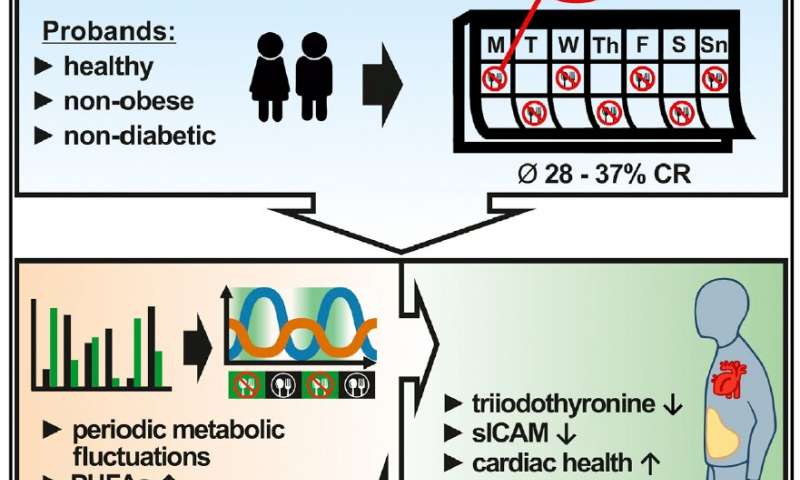
In recent years there has been a surge in studies looking at the biologic effects of different kinds of fasting diets in both animal models and humans. These diets include continuous calorie restriction, intermittent fasting, and alternate-day fasting (ADF). Now the largest study of its kind to look at the effects of strict ADF in healthy people has shown a number of health benefits. The participants alternated 36 hours of zero-calorie intake with 12 hours of unlimited eating. The findings are reported August 27 in the journal Cell Metabolism.

12-clinicaltria

“Strict ADF is one of the most extreme diet interventions, and it has not been sufficiently investigated within randomized controlled trials,” says Frank Madeo, a professor of the Institute of Molecular Biosciences at Karl-Franzens University of Graz in Austria. “In this study, we aimed to explore a broad range of parameters, from physiological to molecular measures. If ADF and other dietary interventions differ in their physiological and molecular effects, complex studies are needed in humans that compare different diets.”

In this randomized controlled trial, 60 participants were enrolled for four weeks and randomized to either an ADF or an ad libitum control group, the latter of which could eat as much as they wanted. Participants in both groups were all of and were healthy. To ensure that the people in the ADF group did not take in any calories during fast days, they underwent continuous glucose monitoring. They were also asked to fill in diaries documenting their fasting days. Periodically, the participants had to go to a research facility, where they were instructed on whether to follow ADF or their usual diet, but other than that they lived their normal, everyday lives.

Additionally, the researchers studied a group of 30 people who had already practiced more than six months of strict ADF previous to the study enrollment. They compared them to normal, healthy controls who had no fasting experience. For this ADF cohort, the main focus was to examine the long-term safety of the intervention.

“We found that on average, during the 12 hours when they could eat normally, the participants in the ADF group compensated for some of the calories lost from the fasting, but not all,” says Harald Sourij, a professor at the Medical University of Graz. “Overall, they reached a mean calorie restriction of about 35% and lost an average of 3.5 kg [7.7 lb] during four weeks of ADF.”

The investigators found several biological effects in the ADF group:

  • The participants had fluctuating downregulation of amino acids, in particular the amino acid methionine. Amino acid restriction has been shown to cause lifespan extension in rodents.
  • They had continuous upregulation of ketone bodies, even on nonfasting days. This has been shown to promote health in various contexts.
  • They had reduced levels of sICAM-1, a marker linked to age-associated disease and inflammation.
  • They had lowered levels of triiodothyronine without impaired thyroid gland function. Previously, lowered levels of this hormone have been linked to longevity in humans.
  • They had lowered levels of cholesterol.
  • They had a reduction of lipotoxic android trunk fat mass—commonly known as belly fat.

“Why exactly calorie restriction and fasting induce so many beneficial effects is not fully clear yet,” says Thomas Pieber, head of endocrinology at the Medical University of Graz. “The elegant thing about strict ADF is that it doesn’t require participants to count their meals and calories: they just don’t eat anything for one day.”

The investigators point to other benefits that ADF may have, compared with continuous calorie restriction. Previous studies have suggested calorie-restrictive diets can result in malnutrition and a decrease in immune function. In contrast, even after six months of ADF, the immune function in the participants appeared to be stable.

“The reason might be due to evolutionary biology,” Madeo explains. “Our physiology is familiar with periods of starvation followed by food excesses. It might also be that continuous low-calorie intake hinders the induction of the age-protective autophagy program, which is switched on during breaks.”

Despite the benefits, the researchers say they do not recommend ADF as a general nutrition scheme for everybody. “We feel that it is a good regime for some months for obese people to cut weight, or it might even be a useful clinical intervention in diseases driven by inflammation,” Madeo says. “However, further research is needed before it can be applied in daily practice. Additionally, we advise people not to fast if they have a viral infection, because the immune system probably requires immediate energy to fight viruses. Hence, it is important to consult a doctor before any harsh dietary regime is undertaken.”

In the future, the researchers plan to study the effects of strict ADF in different groups of people including people with obesity and diabetes. They also plan to compare ADF to other dietary interventions and to further explore the molecular mechanisms in animal models.

CDSCO is blowin’ in the wind

In a letter addressed to Prime Minister Modi dated August 28, 26 manufacturers from the Punjab Drug Manufacturers Association (PDMA) have given details of the corrupt practices at the CDSCO/DCGI and its impact on the spirit of ‘entrepreneurship/ industry which is the backbone of the economy.’

Unknown

The letter comes after Dr Naresh Sharma, Deputy Drug Controller at the Delhi headquarters of Central Drugs Standard Control Organisation (CDSCO) was arrested by the the Central Bureau of Investigation (CBI) on August 16. This follows the arrest of Ankur Bansal, a Baddi-based CDSCO drug inspector who was caught red-handed accepting Rs 1 lakh bribe from officials of Amritsar-based Kwality Pharma.

The CBI has reportedly found other cases with the same modus operandi: failing batches and then approving them for a price. The CBI has reportedly either arrested or picked up at least two more senior officials, one formerly with the CDSCO and the other formerly in the Ministry of Health & Family Welfare. An Assistant Drug Controller from Himachal Pradesh has also been arrested by the vigilance cell while another, referred to as the “most high income earning officer” has been transferred from the state drug inspectorate to the state health department protect him from the CBI!

The CDSCO moved fast to distance itself from Dr Sharma, suspending him in two days. And stating that it has ‘zero tolerance towards corruption and is committed to act stringently against any act of corruption.’ The CDSCO has attempted to clean up its act, with multiple transfers of inspectors last March. (www.expresspharma.in/editors-note/a-spring-cleaning-at-the-cdsco/; www.expresspharma.in/editors-note/going-beyond-cosmetic-changes/) The CBI raids could be a continuation of this clean up process.

But drug inspectors have another take. One senior inspector worries that the CBI is being used to coerce the few honest officers left in CDSCO who have suffered the brunt for not toeing the line i.e. asking for bribes. The PDMA letter quotes drug inspectors justifying bribes as a way to recover the bribes they paid to get these positions!

And for every bribe taker, there is also a giver.

So, shouldn’t the senior managements of pharma companies ensure that their staff down the line do not offer bribes?

If the regulators themselves feel targeted, what about the regulated? As a promoter of an SME pharma company puts it, “We are exploited by inspectors all over India because they use the danda (stick) given by the Drugs Act 1940 whereas they should be facilitators.” He welcomes the immediate penal action against Dr Sharma, in the hopes that it will be a deterrent, as this is “just the tip of the iceberg.” He alleges that there is rampant bribing, with the benefits flowing to the very top. Other sources question how the CBI stepped in only after top ranking officials were moved out of the health ministry.

The same SME pharma source alleges that the product tests are routinely manipulated by faking reports to show out of range assay results, or the presence of ‘related substances’ or ‘impurities’. Almost 99 per cent of the samples from the SME sector are thus deemed ‘Not of Standard Quality’ (NSQ), hinting that bigger players have made deals with the drug testing laboratory staff.

Is this sour grapes on the part of the SME sector? SME pharma players today face rising costs due to multiple issues as detailed in the PDMA letter. The result is poor balance sheets and banks refusing to give loans to SMEs, sending them into a tailspin.

While the reputation of India’s drug regulator is taking a severe beating, observers agree that just as GMP violations are not confined to India alone, there have been black sheep among the staff of global regulators as well.

The point is, will the CBI go the whole way? Does the CBI have its own agenda? Will the few good men and women left in the CDSCO persevere? Or perish, when they refuse to fall in line?

CDER Warns Chinese, Indian Manufacturers

The US Food and Drug Administration’s (FDA) Center for Drug Evaluation and Research (CDER) on Tuesday released two warning letters sent recently to India-based active pharmaceutical ingredient (API) manufacturer CTX Lifesciences Private Ltd and China-based drug manufacturer Ningbo Pulisi Daily Chemical Products Co.

Unknown

Following a six-day inspection at CTX Lifesciences, FDA found that the firm did not ensure that the water used for parenteral grade APIs was suitable for its intended use. For example, FDA said that although the firm was aware that its non-sterile APIs are intended for sterile injectable drug product manufacturing, CTX failed to monitor and control the water used in certain “rinse steps for endotoxins.”

The agency also found that the firm invalidated an out-of-specification (OOS) related substances test result for certain API batches listed in a pending drug application without scientific justification. And the firm did not adequately investigate all potential causes of the unknown impurity.

“Until you correct all deviations completely and we confirm your compliance with CGMP, FDA may withhold approval of any new applications or supplements listing your firm as a drug manufacturer,” the letter adds.

Meanwhile, the letter sent to China’s Ningbo Pulisi, which was placed on import alert in June and produces a foaming acne scrub, shampoo and hand sanitizer, among other over-the-counter (OTC) drug products, cited the company’s failure to test the products for their active ingredients.

“For example, you did not test drug products Halsa Anti-Dandruff Shampoo and Oil Free Acne Wash for their labelled active ingredients zinc pyrithione and salicylic acid, respectively, prior to release,” FDA said. “Your firm also lacked adequate testing for critical microbial attributes (e.g., absence of objectionable microorganisms).”
In addition, Ningo failed to adequately test incoming raw materials, including APIs and other components, for identity, purity, strength and quality.

“You used raw materials, including active ingredients, for drug manufacturing only after evaluating materials for appearance and smell,” FDA investigators said following a four-day inspection last February.

AmEx Pharmacy/Pacifico National

In addition to the two warning letters, FDA also requested a recall recently of all purportedly sterile drug products from a Florida-based facility of Pacifico National (also known as AmEx Pharmacy).

FDA said the firm received complaints related to patients experiencing eye issues, such as floaters and inflammation, although the company’s director of quality operations informed FDA investigators that the complaints have not been investigated. Some of the complaints involved Avastin products.

“FDA has determined that due to the lack of sterility assurance in producing purportedly sterile products…these products represent a serious health hazhard that outweighs the potential, if any, of a drug shortage,” the agency said in a letter to the company.

Purdue Pharma Might Pay $10-12 Billion to Settle Opioid Lawsuits, File Bankruptcy

Purdue Pharma could be positioning itself to settle thousands of lawsuits related to the opioid crisis for a reported $10 to $12 billion.

8ab25d77-e630-4131-b7e1-ee3285fc9b02

According to “people familiar with the matter,” the company and its owners, the Sackler family, are plotting out a way to end the vast number of lawsuits filed against the company over its marketing practices for OxyContin and other opioid products. Earlier this year, the company reached a $270 million settlement with the state of Oklahoma for its role in the opioid crisis in that state. Still, there are some lawsuits left to be decided that could cost the company a considerable amount in damages, including two significant cases in Boston and Ohio.

Citing an unnamed source, Reuters said the company held meetings last week in Cleveland with numerous plaintiffs from state and local governments, the entities behind many of the lawsuits seeking financial restitution for public funds used to combat opioid addiction. According to the sources, the Sackler family and Purdue executives set out a plan to file for Chapter 11 bankruptcy protection “as a mechanism for implementing the settlement.” Under that settlement agreement, the Sackler family would cede control of the company, Reuters said. The source said the company has until Friday to provide an update to a federal judge on the proceedings, Reutersnoted.

This isn’t the first time there have been rumors the company was seeking bankruptcy protection. In March, there was speculation the company would do that to halt the lawsuits and allow the company to negotiate legal claims with plaintiffs.

A trial date for the Ohio trial, which has consolidated approximately 2,000 opioid lawsuits, is set for Oct. 21. That particular trial will include Purdue, as well as other pharma companies that manufacture opioids, such as Teva and Johnson & Johnson. Reuters said U.S. District Judge Dan Polster, who is overseeing this case, has been pushing for settlements. He said he was hoping to see settlements that could “do something meaningful to abate this (opioid) crisis,” Reuters said.

The Sackler family has been criticized and denigrated for its role in the aggressive marketing of OxyContin, the pain killer that has become the poster drug for the opioid crisis. Documents from the court case in Boston highlighted some of the Sackler executives’ desire to profit from the sale of the opioid. Court documents released earlier this year revealed that Richard Sackler, a former Purdue president, called for a “blizzard of prescriptions” during a launch party for OxyContin shortly after the drug had been approved by the U.S. Food and Drug Administration.

For its role in running the company, the Sackler family has suggested that its role on the board of directors was to largely oversee routine management decisions and did not have control over the marketing of the drug, Reuters said. Until recently, the Sackler family name was largely unattached to the opioid drug, despite the fact that they took home more than $4 billion from sales of OxyContin.

In its report, Reuters said Paul Hanly, a lead attorney for the plaintiffs called the report “made up” and ridiculous. BioSpace reached out to Purdue Pharma regarding the potential settlement plan, which was first reported by NBC.

“While Purdue Pharma is prepared to defend itself vigorously in the opioid litigation, the company has made clear that it sees little good coming from years of wasteful litigation and appeals. The people and communities affected by the opioid crisis need help now. Purdue believes a constructive global resolution is the best path forward, and the company is actively working with the state attorneys general and other plaintiffs to achieve this outcome,” Purdue said in a statement to BioSpace this morning.

According to that report though, the company would undergo a restructuring plan to turn itself into a for-profit “public benefit trust” for a period of at least 10 years. The company would contribute $7 to $8 billion to the trust from the sale of its drugs, while the remaining billions would come from Purdue’s cash and insurance policies, Reuters said.

Google is Now a Pharmaceutical Company

Big Tech has Merged with Big Pharma

July 7, 2019 — Gary Null & Richard Gale have documented that Google now has a pharmaceutical division headed by GlaxosSmithKline’s former chairman of its global vaccine business. Null & Gale write:

Google today is not only a weapon for promoting the pharmaceutical agenda but now also a drug company itself. During the past six years, Google’s parent company Alphabet has launched two pharmaceutical companies. In 2013, it founded Calico, run by Genentech’s former CEO Arthur Levinson. Calico operates an R&D facility in the San Francisco Bay Area for the discovery of treatments associated with age-related diseases. Two years later, Alphabet founded Verily Life Sciences (previously Google Life Sciences). Both pharma companies are partnering with other drug corporations. Recently, Verily has partnered with the European pharmaceutical giant GlaxoSmithKline to form a new drug company, Galvani Bioelectronics for the development of “bioelectronic medicines.” The collaboration is costing the companies $715 million, and the new firm is being chaired by Glaxo’s former chairman of its global vaccines business. (emphasis added) http://prn.fm/gary-null-show-wikipedia-silicon-valleys-cult-medical-misinformation-07-01-19/ 

google-drug-fine-300x187

In addition, Google’s president of Customer Solutions Mary Ellen Coe now sits on Merck’s Board of Directors. Merck is one of the world’s “Big Four” vaccine manufacturers. Pharmaceutical companies have realized the need to co-opt social media platforms as well as the world’s most powerful search engine – Google.

This strategy, laid out 6 years ago, has picked up steam whereby now companies such as Google and Facebook have been absorbed into the pharmaceutical machinery. The dire results from this marriage already being felt as Wikipedia and other virtual social media have become just another mouthpiece for Big Pharma.
http://prn.fm/gary-null-show-wikipedia-silicon-valleys-cult-medical-misinformation-07-01-19/

Google has earned over $1 billion from illegal online pharmacies, and may be fined up to $500 million by the US Department of Justice. https://www.stopoxy.com/google-fine-prescription-drugs-online-ads-oxycontin-percocet-ritalin-ativan-ambien-7-6-11

While Google profits from Big Pharma, it is erasing Dr. Joseph Mercola from it’s search engine results. Dr. Mercola is a medical doctor dedicated to natural health and remedies. He is the exact opposite of everything Google is profiting from with their marriage with Big Pharma. https://articles.mercola.com/sites/articles/archive/2019/06/24/google-latest-algorithm-update-buries-mercola.aspx

Another Tech-Giant that is making money with Big Pharma is Amazon, a company that has been purging Vaccine Risk Awareness books and movies (including the documentary VAXXED) from their website. TheStreet.com reports:

… Amazon acquired for $1 billion PillPack, a business that presorts medications, then ships them directly to customers’ homes in 49 states.

TheStreet.com report goes on to detail how Amazon is working with a drug firm to identify patients who will be eligible for experimental cancer drugs by scanning and researching patient records.

This is why Google, Amazon, Facebook and others are trying to erase and discredit all Vaccine Risk Awareness books, posts, websites, information, pages, etc… – because Big Tech has merged with Big Pharma. They are one-in-the-same and have the same agenda.

*** Find more evidence Google is now a Pharmaceutical Company at these links:

Google sister-company Verily is teaming with big pharma on clinical trialshttps://www.cnbc.com/2019/05/20/alphabet-verily-doing-clinical-trials-with-novartis-sanofi-pfizer.html

We see Verily’s technology as a way for us to reach patients and get them interested,” said Badhri Srinivasan, head of global development operations at Novartis. In an interview, Srinivasan shared an example of engaging people who are already searching on Google for relief from asthma symptoms. At that point, Verily could surface an ad to suggest they enroll in its clinical trial patient registry, dubbed Baseline, and sign up for relevant asthma-related clinical trials if they chose to do so. (emphasis added)

Regulatory Explainer: Everything You Need to Know About Biosimilars

For more than a decade now, biotech and pharmaceutical companies have brought a new class of treatments – biosimilars – to markets around the world (from the EU to India to South Korea to the US), offering cost savings for some of the most expensive medicines, though even in 2016, decades after companies began their quest to develop biosimilars, they are still only just beginning to see widespread adoption.

What is a Biosimilar?

A biosimilar medicine (also sometimes known as a “follow-on biologic,” “subsequent-entry biologic” or “follow-on protein product”) is a medicine that is similar to another, already-authorized biologic medicine (including vaccines, blood and blood components, allergenics, somatic cells, gene therapies, tissues and recombinant therapeutic proteins).

As the US Food and Drug Administration (FDA) notes: Both biologics and biosimilars are isolated from a variety of natural sources – human, animal or microorganism – and can be composed of sugars, proteins, nucleic acids or complex combinations of these substances, or they may even be living entities, such as cells and tissues.

In the US and EU, the two biggest markets for biosimilars so far, a biosimilar must have no clinically meaningful differences in terms of quality, safety and effectiveness from the biologic that it is mirroring and is already authorized (that already authorized product is known as the reference product in the US).

Likewise, in both markets, companies have to carry out studies showing that the biosimilar is similar to the reference biologic and does not have any meaningful differences from the reference medicine in terms of quality, safety or efficacy.

However, as the European Medicines Agency (EMA) notes, data on a biosimilar’s reference biologic and the way it is used and made are already available, meaning the amount of data on safety and efficacy needed to win approval for a biosimilar is usually less than the amount needed to authorize the original biologic.

Why are Biosimilars Different From Generics?

Biosimilars and generics differ not only in size, stability and characterization, but also in how they are made, how they behave over time and their mode of action.

A lot of debate has been brewing about the comparisons between generics (which must be identical to their reference products) and biosimilars (which have a natural degree of variability, like with all different lots of the same biologic), with some media outlets calling biosimilars “copycats,” or “knockoffs,” though such euphemisms can oversimplify what is actually being developed.

Many in the pharmaceutical and biotech industries often to refer to generics as small molecule drugs and to biologics and biosimilars as large molecule drugs – meaning the molecules used as the active substances are either small (which for generics means they are synthesized by chemical reactions between different organic and/or inorganic compounds) or large (meaning they are composed of more than 1,000 amino acids and can be produced via modified cells of microorganisms, such as bacteria, yeast or in mammalian cell lines).

The Generics and Biosimilars Initiative (GaBI) offers a good example of the differences between a generic and biosimilar: An aspirin, which is a small molecule drug, measures just 180 daltons (a dalton is the standard unit used to indicate mass on an atomic or molecular scale) and has 21 atoms. That aspirin has a limited ability to initiate an immune response (how a body recognizes and defends itself against substances that appear foreign and harmful) and remains relatively stable over time. However, a biosimilar, which can be a monoclonal antibody or cell signaling protein, measures 150,000 daltons, contains 20,000 atoms, degrades over time and can generate a significant immune response.

As the Biotechnology Innovation Organization notes, differences between generic and biosimilar manufacturers are extensive. Biologics and biosimilars manufacturers must ensure consistency, quality and purity by ensuring that the manufacturing process remains substantially the same over time, whereas a small molecule manufacturer can change the manufacturing process extensively and analyze the finished product to establish that it is the same as before the manufacturing change.

Because of the complexity of biosimilars and the difficulty of manufacturing them, the cost of any given biosimilar is generally higher than the cost of a generic. And even as more biosimilars come to market and create more competition for costly biologics, the price difference between biosimilars and their reference products (biosimilars in the EU have typically been 15-30% cheaper) may never be as wide as the price difference between generics and their reference products.

Still, according to IMS, some EU countries are seeing a major impact from the introduction of biosimilars (though those cost savings may not be seen in the US until interchangeable biosimilars hit the market (see more in the Interchangeability section below)).
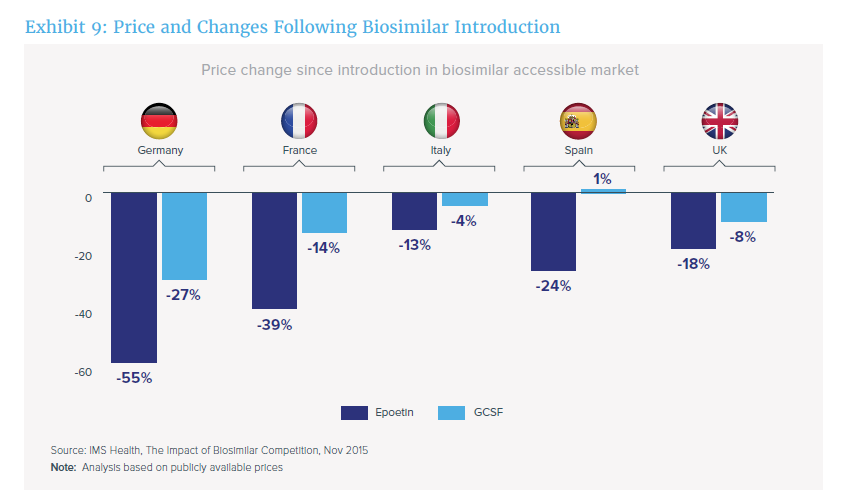
biosim price

For the US, the potential cost savings is still to be determined, though current estimates will have to factor in a number of the issues outlined later on in this explainer.

IQVIA also offers a look at where the first biosimilars will become available first over the next ten years:
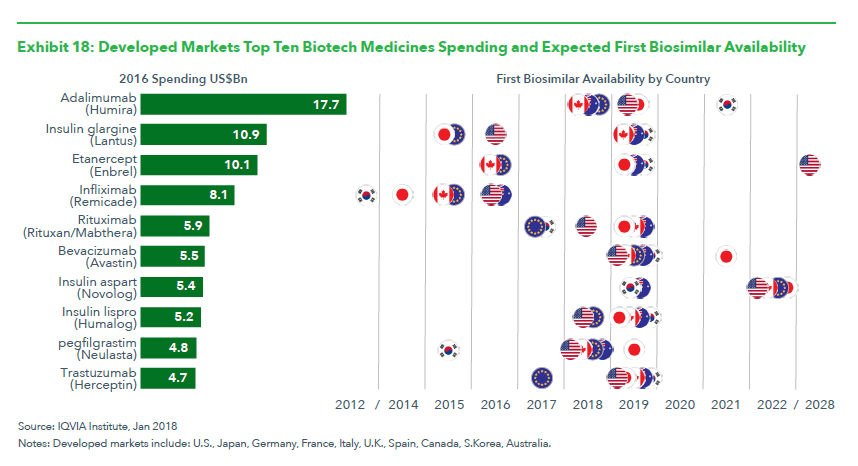
IQVIA

A number of other cost-related factors for US biosimilar savings were also outlined by CVS in a report (chart below).
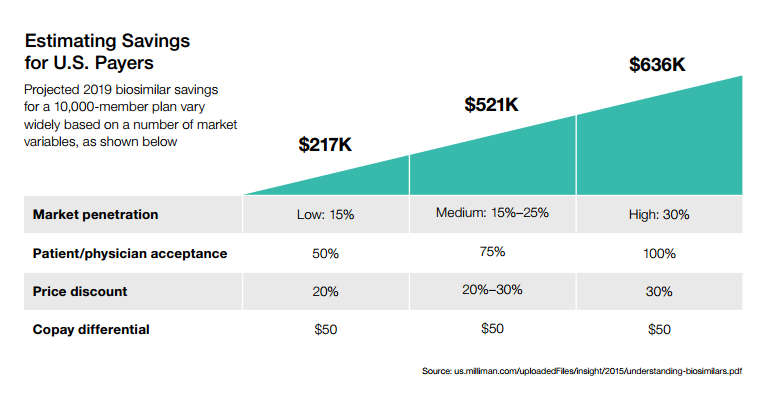
CVS

And as the pipeline of biosimilars continues to swell, more competition may mean lower-cost treatments (though many of these biosimilars have either been approved or submitted for approval since this chart was published – more on approvals below).
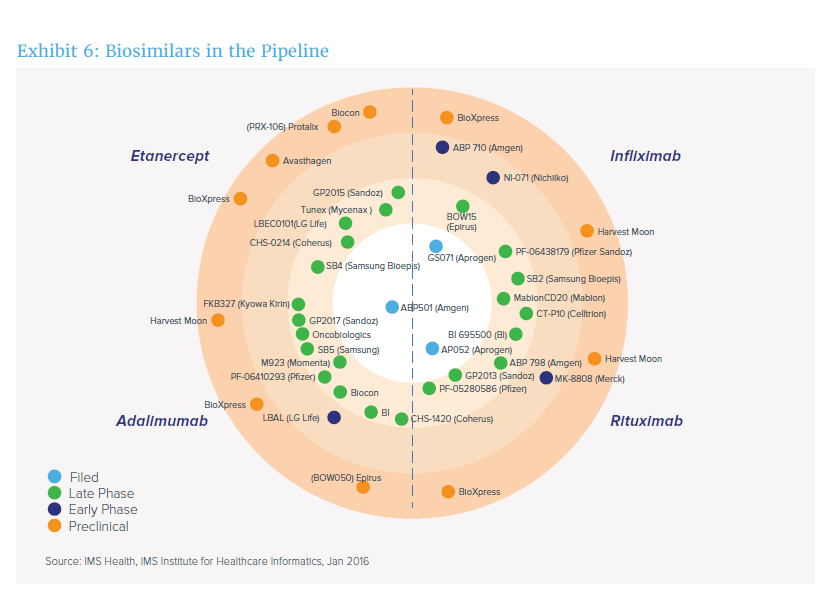
biosim pipeline

What Biosimilars are Approved and Where?

For the EU – which is the trendsetter – the experience with biosimilars (which can only be approved after the reference biologic has been on the market for 10 years – two years less than in the US, though in the US, a biosimilar can be filed four years after FDA approval of the reference biologic) has been relatively smooth, with more than 20 biosimilars approved between December 2006 and January 2018.

Remicade biosimilars now have 53% of EU market share when compared with their reference products, while Enbrel biosimilars see 29% market share and Rituxan (rituximab) biosimilars, which have yet to be approved in the US but are coming, have gained 13% of market share, according to Bernstein biotech analyst Ronny Gal.

In the US, however, FDA has authorized the use of nine biosimilars (and only three have actually come to market): Sandoz’s Zarxio (filgrastim-sndz), which is similar to Amgen’s Neupogen, competition for Enbrel with Erelzi (etanercept-szzs), which has yet to hit the US market and has patent protection through 2029; for Avastin with Mvasi (bevacizumab-awwb), which may not come to market in the US until early 2019; for Humira with Amjevita (adalimumab-atto) and Cyltezo (adalimumab-adbm) and for Herceptin with Ogivri (trastuzumab-dkst), which was approved in December 2017, though the launch date remains unknown. Pfizer’s Ixifi (infliximab-qbtx) was also approved in December 2017, though the company said it will not launch the product.

Remicade also has two biosimilar competitors approved by FDA – Samsung Bioepis’ Renflexis (infliximab-adba) and Celltrion and Pfizer’s Inflectra (infliximab-dyyb), both of which have launched, but uptake has been modest, barely scraping 5% of the market. The only other biosimilar to launch is Zarxio (filgrastim-sndz).

FDA is likely to approve more in the coming years, and the term biosimilar is tricky in the US as some approved follow-on biologic products, like insulins, are sometimes considered biosimilars, though FDA has said that in some cases, like with Eli Lilly’s Basalgar, they are not biosimilars as they are approved via a 505(b)2 application that relied partly on the application for Sanofi’s Lantus.

As of January 2018, 60 biosimilars were enrolled in the FDA’s biosimilar development program, and FDA has received meeting requests to discuss the development of biosimilars for 27 different reference biologics.

In India, which according to GaBI is actually ahead of the EU in terms of number of approvals, though the approval standards are not the same, more than 60 biosimilars have been approved since 2000. Guidance from the Central Drugs Standard Control Organization was first issued in 2012 and then updated in March 2016.

Japan’s Ministry for Health, Labour and Welfare (MHLW) has approved nine biosimilars (which includes insulins) between 2009 and 2016, according to GaBI, and released industry guidance on biosimilars back in 2009 (for more perspective on Japan’s experience with biosimilars, check out this article in The Lancet from officials from Japan’s Pharmaceuticals and Medical Devices Agency).

South Korea’s Ministry of Food and Drug Safety (MFDS), meanwhile, has approved six biosimilars between 2012 and 2015, and also published guidance back in 2009, relying on EU, Japanese and WHO biosimilar guidance.

Approval Pathways

In the US, a Biologics License Application (BLA) is a request for permission to introduce, or deliver for introduction, a biologic into interstate commerce. The BLA is regulated under 21 CFR 600 – 680 (Form 356h specifies the requirements for a BLA). 

Under the Biologics Price Competition and Innovation Act of 2009 (BPCIA), enacted in March 2010, as part of the Patient Protection and Affordable Care Act (better known as Obamacare), a proposed biologic that is biosimilar to an FDA-approved biologic (the reference product) can use the abbreviated approval pathway under section 351(k) of the Public Health Service Act(PHS Act).

FDA’s biosimilar lead Leah Christl explained to Focus in June 2016: “The data packages differ between originator and biosimilar marketing applications, but the standard for approval of originator products under 351(a) and biosimilar products under 351(k) of the PHS Act is the same in that both must demonstrate that they are safe, pure, and potent for the approved conditions of use.”

In addition, she said:

  • The sponsor of the proposed biosimilar product does not have to independently establish the safety and effectiveness of its product; it establishes this through a demonstration of biosimilarity to the reference product. 
  • The sponsor of a proposed biologic demonstrated to be biosimilar to a reference product can rely on FDA’s previous finding of safety, purity, and potency (i.e., safety and effectiveness) for the reference product. “The ability to rely on certain existing scientific knowledge about the reference product to support the safety, purity, and potency (i.e., safety and effectiveness) of the biosimilar product allows for a potentially shorter and less costly drug development program. This is what is meant by an abbreviated approval pathway.”
  • The abbreviated pathway is not a lesser standard for approval.
  • The data packages differ between originator (351(a) BLA) and biosimilar (351(k) BLA) marketing applications, but the standard for approval of originator and biosimilar products “is the same in that both must demonstrate that they are safe, pure, and potent for the approved conditions of use. 
  • “The data package required for approval of a biosimilar product is quite extensive; it is the approval pathway that is abbreviated.”  

As far as industry concerns with FDA’s interpretation of the BPCIA, Sanofi, Mylan, Novo Nordisk, and industry groups PhRMA and the Biosimilars Council in May 2016 called on FDA to amend its interpretation of the “deemed to be a license” provision of the Act as some are saying the current draft guidance could halt biosimilar development for a prolonged period.

In addition to the 351(k) pathway, the Federal Food, Drug, and Cosmetic Act (the FD&C Act), as amended by the Biosimilar User Fee Act of 2012 (BsUFA), FDA can assess and collect fees for biosimilars from October 2012 through September 2017. The user fee program was reauthorized in August 2017 and will now extend through 2022 with additional fees.

FDA dedicates these fees (the latest of which can be found here) to expediting the review process for biosimilars.

On the EU end, a pathway for approving biosimilars has been in place since 2003.

“The main part of the evaluation is a comparison of the biosimilar with its reference medicine to show that there are no significant differences between them,” EMA says. “The relevant regulatory authority applies stringent criteria in their evaluation of the studies comparing the quality, safety and effectiveness of the two medicines. The studies on quality include comprehensive comparisons of the structure and biological activity of their active substances, while the studies on safety and effectiveness should show that there are no significant differences in their benefits and risks, including the risk of immune reactions.”

And like with the US, because the reference medicine has been authorized in the EU for a decade (12 years in the US) and its clinical benefit is well established, some studies carried out with the reference medicine may not need to be reproduced, EMA says.

Names

In the EU, biosimilars use a unique proprietary name but the same nonproprietary name (also known as an international nonproprietary name or INN) as their reference product, like with generics. For example, Biogen and Samsung’s Benepali (approved in the EU in January 2016) is biosimilar to Amgen’s Enbrel, and both use the non-proprietary name of etanercept.

In the US, however, biosimilar names have stirred up controversy, mostly because of a requirement (from naming guidance released in August 2015) to add a four-letter suffix at the end of a biosimilar’s nonproprietary name.

Industry groups commenting on the guidance, including the Biosimilars Forum, PhRMA and BIO, supported FDA’s proposal, but called for the agency to use “meaningful” and “distinguishable” suffixes linked to the license holder’s name, just like what was used for the first US-approved biosimilar, known as Zarxio (filgrastim-sndz).

BIO and PhRMA are also calling for biosimilar labels to describe the basis of approval for each indication with relevant data for the reference product and biosimilar.

However, the Biosimilars Council opposed FDA’s proposal, claiming that “adding a suffix … is unnecessary and does not achieve the Agency’s stated goals as it will lead to confusion among prescribers and patients.” Its comment goes on to argue that these products “have other names … for distinct recognition; including a brand name, company name, a lot number and a national drug code (NDC) number that readily distinguish [them] from other products.”

Insurers such as the Kaiser Foundation, CVS Health and America’s Health Insurance Plans (AHIP) fell in line with the Biosimilars Council’s stance, opposing the use of a suffix in favor of other measures to distinguish biosimilars for pharmacovigilance purposes.

The suffix is meant to help better track the safety and use of biosimilars, though alongside that guidance, FDA also proposed a rule to designate the proper names of six already approved biologics (which also are expected to get new names).

The products include filgrastim, pegfilgrastim, infliximab and epoetin alfa, each of which is a reference product for “an approved or publicly disclosed section 351(k) application,” a related biological product, tbo-filgrastim, and a biosimilar, filgrastim-sndz.

The rule proposes assigning a suffix to each of the six products, or replacing the product’s previous suffix (or prefix, in the case of tbo-filgrastim).

For example, Amgen’s Neupogen (filgrastim) would be changed to “filgrastim-jcwp,” while Sandoz’ Zarxio (filgrastim-sndz) would be renamed “filgrastim-bflm.” For the biosimilar Granix (tbo-filgrastim), FDA has proposed removing the prefix “tbo” and adding a new suffix, “filgrastim-vkzt.” The agency says it believes changing the names of these products will help “avoid confusion regarding these products relationships to one another.”

Additionally, by using only suffixes, related or similar products can be “grouped together in electronic databases,” while remaining distinguishable.

The agency also says it is considering alternative names for these specific products that would still use a four letter suffix, but where the suffix is based on the product license holder’s name, such as “amgn” for Amgen, or “jnsn” for Janssen.

The issue has been so controversial that FDA in June 2016 released a document calling on companies to select 10 suffixesdevoid of meaning for biosimilar and biologic names, though the agency then withdrew that document three weeks later and FDA’s Christl has since clarified that companies should submit one to three suffixes.

WHO, meanwhile, has drafted a proposal to use what it calls a “biological qualifier” to further distinguish biosimilars from their reference products.

Both BIO and PhRMA have urged FDA to engage with WHO and other stakeholders to discuss harmonization, and the Federal Trade Commission (FTC) and USP have offered support for WHO’s approach, with the FTC saying: “unlike FDA’s proposed suffix, which would be part of the nonproprietary name, the [biological qualifier] would be separate from the nonproprietary name in pharmacy databases.”

Labels

In March 2016, FDA unveiled draft guidance on biosimilar labels, which will rely heavily on their reference products’ labels, though the biologics industry will likely be happy that the labels must make certain clarifications about the biosimilar and reference product.

FDA says that like with generics, biosimilar labeling should include a description of the clinical data that supported safety and efficacy of the reference product. 

But in circumstances where a biosimilar is not approved for the same indications as its reference product, unlike with generic drugs, FDA notes that “it may be necessary to include information in the biosimilar product labeling relating to an indication(s) for which the biosimilar product applicant is not seeking licensure, in order to help ensure safe use (e.g., when safety information in the reference product labeling is related to use of the product and is not specific to a particular approved indication(s) or when information specific to only the biosimilar product’s indication(s) cannot be easily extracted).”

And the label should be written in a manner that does not imply that the biosimilar product is approved for a reference product indication(s) or use(s) that has not been approved for the biosimilar product, the draft guidance says.

“The overall risk-benefit profile of the reference product is relevant to the biosimilar product, even if a particular serious adverse reaction or other risk included in the reference product labeling may not have been reported with the biosimilar product at the time of licensure,” FDA adds.

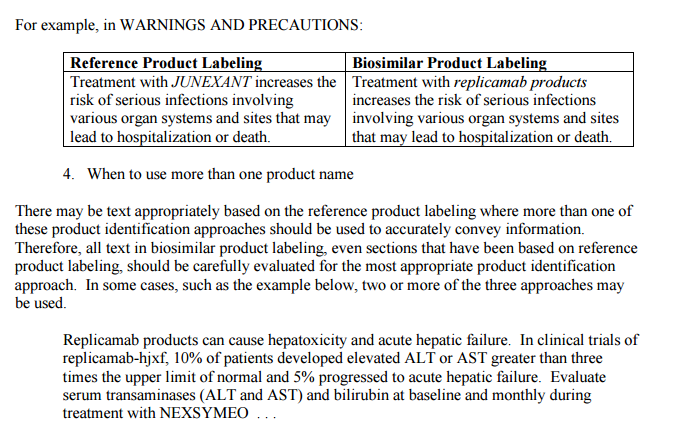
FDA also offers illustrative examples with a fictional reference product JUNEXANT (replicamab-hjxf) and a fictional biosimilar product NEXSYMEO (replicamab-cznm).

In labeling sections where the risk applies to both the biosimilar product and the reference product (e.g., BOXED WARNING, CONTRAINDICATIONS, WARNINGS AND PRECAUTIONS, ADVERSE REACTIONS (Postmarketing Experience)), it would be appropriate to use the core name of the reference product followed by the word “products” (i.e., replicamab products) to convey, for example, that a risk or other information necessary for the safe use of the product applies to both the biosimilar and the reference product.

In sections where the information described is specific to the biosimilar product — i.e. INDICATIONS AND USAGE, DOSAGE AND ADMINISTRATION, DOSAGE FORMS AND STRENGTHS, DESCRIPTION, and HOW SUPPLIED/STORAGE AND HANDLING – FDA says:

  • For directive statements and recommendations for preventing, monitoring, managing, or mitigating risks (e.g., “Discontinue NEXSYMEO in patients with [adverse reaction]”) — Such statements are typically included in, but are not limited to, the BOXED WARNING, CONTRAINDICATIONS, WARNINGS AND PRECAUTIONS, and DRUG INTERACTIONS sections.
  • When clinical studies or data derived from studies with the reference product are described in the biosimilar labeling, the reference product’s proper name should be used. This information would typically be included in sections such as, but not limited to, ADVERSE REACTIONS (Clinical Trials Experience) and CLINICAL STUDIES.biosim

    Interchangeability

    The biggest difference between the EU and US biosimilar markets is “interchangeability,” a yet-to-be-fully-explained term used to describe biosimilars in the US for which additional studies were conducted to evaluate multiple switches between the reference product and biosimilar. Though no interchangeable biosimilars have been approved in the US, FDA has said the first may come to market in the next two years. The term designates a particular class of biosimilars that can be automatically substituted at the pharmacy level.

    In January 2017, FDA issued draft guidance on interchangeability, with FDA asking for a multiple switch study with pharmacokinetic endpoints, that the reference product used as the comparator be sourced from the US, and that extensive human factor studies be conducted with the device.Many have commented on the draft interchangeability guidance, though Boehringer Ingelheim is the only company to have publicly disclosed that it is conducting a clinical study designed to meet the interchangeability requirements outlined in the draft guidance.

    The term does not exist in the EU as EMA explains that its evaluations do not include recommendations on whether a biosimilar should be used interchangeably with its reference medicine, and the decisions on switching from one biological medicine to another are referred by EMA to doctors and pharmacists.

    Drug, biologic and biosimilar companies, meanwhile, are debating (in comments on FDA’s draft guidance on biosimilar labeling) over whether to include a biosimilar’s interchangeability status on each new product’s label.

    State Legislation

    Although the BPCIA established the pathway whereby biosimilars can reach the market in the US, states (heavily influenced by lobbyists from the biopharma industry) have taken the matter of substituting biologics for biosimilars into their own hands.

    Twenty-four states (the most recent of which was Pennsylvania in July 2016) and Puerto Rico now have enacted laws creating a patchwork of regulations governing how biosimilars are dispensed, even before biosimilars have hit the market en masse in the US and before FDA has explained what interchangeability means.

    The laws generally require pharmacists to only be allowed to substitute a biosimilar for its reference product if FDA has determined the biosimilar to be interchangeable, and if the prescriber does not prohibit such a substitution, if the pharmacy informs the patient of the substitution and if the pharmacy retains a record of the biosimilar dispensed, and within five business days of dispensing a biosimilar, the pharmacist records what specific product was provided to what patient, including the name of the product and the manufacturer.

Regulatory Explainer: FDA’s Expanded Access (Compassionate Use) Program

What’s a Compassionate Use Program?

Let’s back up for a quick moment: Under current US Food and Drug Administration (FDA) regulations, if a company wants to conduct a clinical trial on a drug, it first needs to obtain regulatory approval to do so. It does this by submitting an investigational new drug (IND) application to FDA, which is essentially an exemption from federal law (which otherwise bans unapproved drugs from entering into interstate commerce) that allows a drug to be manufactured and investigated.

Under the terms of the IND, sponsors are tightly regulated, and are only able to use the drug on patients enrolled in the clinical trial. This is done to ensure that the drug is used safely, that the correct patients are enrolled in the trial, and that all side effects can be monitored.

OK—back to the original question: What is the compassionate use program?

Over the last two decades, FDA has moved to allow sponsors to expand access to their products, more commonly known as “early access programs” or “compassionate use exemptions.”

The intent of these programs is to allow FDA to permit companies to broaden access to investigational products while they’re still undergoing clinical trials.

For example, assume a drug is being tested for one type of cancer. You, however, have a different type of cancer that will almost certainly kill you, and all existing options have failed to treat the cancer. Your doctor believes that the drug being tested for the other type of cancer might be of some benefit.

Under normal IND regulations, FDA would be unlikely to approve research in this case because it would not advance any understanding of the drug’s safety or efficacy. The intent of the expanded access/compassionate use programs, however, is to allow patients who have the most to gain and the least to lose to access an investigational product.

Which Patients are Eligible for the Expanded Access Program?

Not all patients will be eligible for expanded access programs. Only patients with serious or immediately life-threatening diseases with no comparable or satisfactory therapeutic alternatives are eligible. Even then, the company must agree that to provide the drug to the patient and obtain FDA approval under one of several types of special INDs (discussed below).

The most important concept in expanded access programs is that the patient be aware of the risks he or she is undertaking, and that the company minimizes unnecessary risks to the extent possible. For that reason, FDA requires that all proposed uses first be approved by an Institutional Review Board (IRB), and that the patient (or the patient’s parent or guardian) sign an informed consent form.

FDA’s May 2013 guidance, Expanded Access to Investigational Drugs for Treatment Use—Questions and Answers, has more information. FDA has also published numerous guidance documents about expanded access and compassionate use programs.

How Does the Expanded Access Program Work in Regulatory Terms?

Expanded access works, in general, in one of two ways: Either a company with an experimental product creates a new clinical trial for a patient through the use of an IND, or it amends an existing clinical trial to add new types of participants through the use of a “protocol amendment.”

Once a company determines which approach it wants to take, it then needs to decide on how many patients it is willing to accommodate. There are four general types of expanded access INDs and protocols:

  1. Single Patient (Emergency Access): Used to grant access to a single patient who does not have time to obtain written permission from FDA
  2. Single Patient (Regular Access): Used to allow a single patient access to a trial
  3. Intermediate Size: Used for intermediate-sized patient populations
  4. Treatment: Used for large patient populations (i.e. widespread use).

Who Decides if a Patient Can Participate in a Compassionate Use Trial?

The company—not FDA. While FDA often works closely with companies to facilitate wider access to a drug, it is ultimately the sole choice of a company whether to grant expanded access to a drug or not.

Why Wouldn’t a Company Agree to Allow Access?

Companies and regulators alike have expressed some hesitancy about the program.

For companies, expanded access means letting products out of tightly controlled and heavily monitored environments, potentially subjecting the product to incorrect use and previously unknown adverse events, which would still need to be reported to FDA. Such incidents could potentially raise questions for regulators, thereby harming the chance of a product getting to market.

Further, some companies are concerned that expanded access programs could remove the incentive for patients to enroll in clinical trials meant to provide evidence for their drug’s full approval, thereby delaying its approval and harming other patients in the process.

“People at biotech companies therefore often must make emotionally difficult decisions when trying to balance an individual’s early access to a drug still in clinical trials against the company’s obligation to develop drugs for larger groups of patients and ensure these products gain regulatory approval as quickly as possible,” the trade group BIO wrote in March 2014. “In some cases, such early access programs could create a conflict between these two principles.”

Still other companies have cited the cost and staff resources necessary to administer compassionate use programs—a problem most evident in small biotechnology startups which do not yet have any income. Sometimes there are also concerns that there won’t be enough drug product available to supply both existing trials and new clinical trials, putting both groups of patients at risk.

To paraphrase BIO’s remarks again: While you’ll hear much about the one patient who isn’t obtaining access to a drug therapy, you’re unlikely to hear much about the thousands of patients who might have to wait several more months to gain access to an FDA-approved drug. And you’re probably not going to hear much about a company’s manufacturing woes or financial problems at the same frequency on social media either.

Regulators, too, are still wary of the program. “There’s this sense from patients that these are miracle drugs,” said Richard Klein, director of FDA’s Office of Special Health Issues, to the Wall Street Journal in October 2012. That feeling isn’t necessarily true. Even if the drug works-which is far from certain in early-stage clinical trials-the benefit might not amount to much. And worse, the drug may actually hasten a patient’s death, putting regulators in an uncomfortable position.

You Mentioned the Cost to Companies-Can They Charge Patients for Investigational Treatments?

Yes they can. Under a May 2013 guidance document, Charging for Investigational Drugs under an Investigational New Drug Application, FDA confirmed that companies may charge for expanded access treatments as long as they meet a four-part test:

  • The drug must exhibit evidence of a clinical benefit.
  • Data from the trial is essential to obtaining future approval for it.
  • The trial could not be conducted without charging.
  • The amount being charged is reasonable.

The sponsor may either charge the patient directly or the patient’s insurance company, but may only charge for the direct costs of providing the drug-its manufacturing, shipping, monitoring, third-party administration, etc.

Some companies may be wary of charging patients for the drug, however. According to a former FDA official involved in overseeing the compassionate use program, some companies believe that charging a “reasonable” amount may impact their ability to negotiate a higher sale price for the drug at a later date.

What Form Should my Doctor Fill out to Allow me to Participate in an Expanded Access Program?

On 4 February 2015, FDA announced it would dramatically streamline the process used by most physicians to enroll their patients into expanded access trials.

Doctors can now use the FDA Form 3926 to enroll a patient. The form, as outlined in FDA’s draft guidance document, Individual Patient Expanded Access Applications: Form FDA 3926, calls for doctors to submit the following eight pieces of information:

  • Box 1: Patient’s initials (not the full name, to preserve confidentiality) and date of submission.
  • Box 2: Clinical information, including indication, brief clinical history of the patient  (age, gender, weight, allergies, diagnosis, prior therapy, response to prior therapy), and the rationale for requesting the proposed treatment, including an explanation of why the patient lacks other therapeutic options.
  • Box 3: Treatment information, including the investigational drug’s name and treatment plan. This includes the planned dose, route and schedule of administration, planned duration of treatment, monitoring procedures, and planned modifications to the treatment plan in the event of toxicity.
  • Box 4: Letter of authorization (LOA) obtained from the investigational drug’s manufacturer and attached to draft Form FDA 3926, when finalized. An LOA grants FDA the right to reference the application for information to satisfy submission requirements, such as a description of the manufacturing facility, chemistry, manufacturing and controls information, and pharmacology and toxicology information.
  • Box 5: Physician’s qualification statement that specifies the medical school attended, year of graduation, medical specialty, state medical license number, current employment, and job title.
  • Box 6: Physician’s name, address, and contact information, including the physical address, email address, telephone number(s), facsimile number, and IND number, if known. (Or IND number)
  • Box 7: Request for authorization to use Form FDA 3926 for individual patient expanded access to comply with FDA’s requirements for submitting an individual patient expanded access IND.
  • Box 8: Certification statement and signature of the physician certifying that treatment will not begin until 30 days after FDA receives the application unless the submitting physician receives earlier notification from FDA that the treatment may proceed; that the physician will obtain informed consent in compliance with FDA’s regulations in 21 CFR part 50; that IRB review of the expanded access use will be obtained in compliance with FDA’s regulations in 21 CFR part 56; and that in the case of an emergency request, treatment may begin without prior IRB approval provided the IRB is notified of the emergency treatment within 5 working days of treatment.

An old form, known as Form FDA 1571, called for physicians to submit 26 separate types of information and seven attachments, an FDA official said in a blog post explaining the change. In contrast, the new form requires just eight elements and a single attachment.

FDA expects the form to be able to be filled out in 45 minutes instead of 100 hours.

Why do I keep Hearing about Compassionate Use Programs?

Almost by definition, patients eligible for compassionate use programs are in danger of dying. For the patients and family members of those patients, access to experimental medicines can represent one last chance to fight against a disease or condition that will otherwise kill them or their loved ones.

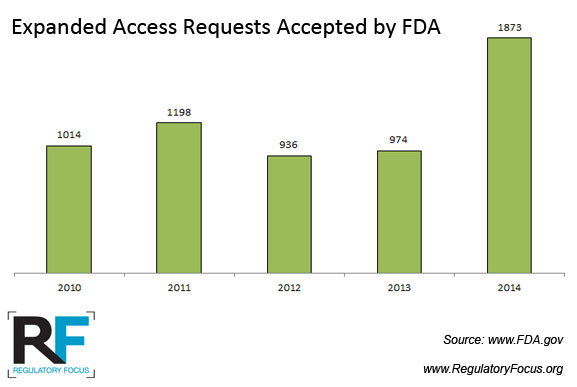
Interest in the program is also growing. According to the Wall Street Journal, participants in the program grew from around 1,000 patients nationwide in 2010 to more than 1,200 in 2012.

And in recent years, the fight to obtain those medicines has taken to social media time and again. In March 2014, for example, Chimerix was the subject of an intense lobbying campaign by the family and supporters of a boy named Josh Hardy. Hardy was suffering from a bacterial infection that had defied other treatments, and was seeking access to the company’s experimental drug, brincidofovir. While Chimerix initially refused to grant Hardy access to the drug, citing the prohibitive cost to the company, it eventually relented.

Similar cases pop up on nearly a daily basis. By way of example:

  • Nick Auden, who had a 500,000-person petition seeking access to a Merck drug
  • Darlene Gant, who sought access to Genentech’s pertuzumab
  • Andrea Sloan, who sought BioMarin Pharmaceuticals’ BMN673
  • Jack Fowler, who sought Shire’s SHP-609

Are Some States Working to Address This Issue as Well?

Yes. Several dozen states have introduced legislation intended to address various aspects of the compassionate use process. Most are primarily intended to shield doctors from being sued by patients, but others are more comprehensive.

Expanded-Access-Requests-Granted-by-FDA

Are Patients Ever Denied Participation in Proposed Expanded Access Programs?

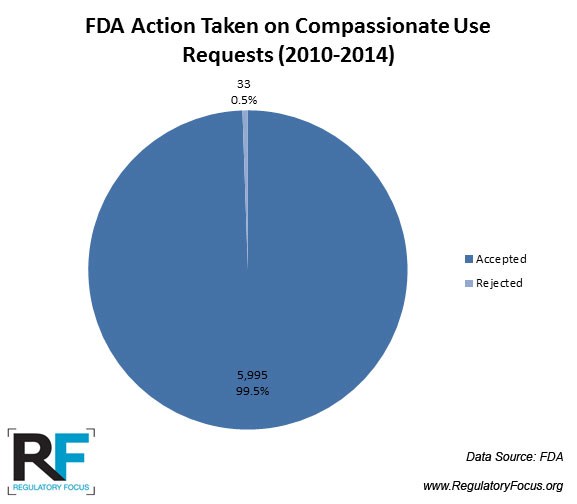
All the time, but rarely by FDA.

FDA data indicate that between 2010 and 2013, it rejected just 24 expanded access INDs, and no expanded access protocols were rejected. The majority of rejections were related single-patient emergency INDs.

Compassionate-Use


CDSCO Clarifies Rules on Importing Drugs for Use in Academic Clinical Trials

CDSCO has clarified the rules on organizations that want to import drugs for use in academic clinical trials. The regulator will waive the need to obtain an import license provided certain conditions are met.

Unknown

Under the New Drugs and Clinical Trial Rules, 2019, academic clinical trials are defined as studies in which an investigator, academic or research institution explores the use of an existing drug in a new context. Clinical trials of existing drugs in new indications, routes of administration, doses and dosage forms qualify, provided the study is not intended to support a filing for approval.

Trials that meet those criteria benefit from slightly different regulatory requirements, including a relaxing of the rules on seeking import licenses. CDSCO explained this week that a copy of the ethics committee approval, stating the quantity of drug being imported and why, can serve as clearance for importation, freeing sponsors of academic studies from the need to obtain a Form 11 license.

https://cdsco.gov.in/opencms/opencms/system/modules/CDSCO.WEB/elements/download_file_division.jsp?num_id=NDg1Ng==

Pfizer Investing $500 Million in North Carolina Gene Therapy Facility, Adding 300 Jobs

Pfizer announced it is putting an additional $500 million into the construction of its gene therapy manufacturing site in Sanford, North Carolina. It is planned to support the company’s investment in gene therapy research and development, much like its R&D sites in Chapel Hill and Kit Creek, North Carolina.

The company indicates it will add about 300 jobs with the expansion. It currently employs 650 people at that site, which is manufacturing Pfizer’s late-stage pipeline drugs for Duchenne muscular dystrophy (DMD) and hemophilia B. It also manufactures some of the components to the company’s vaccines, such as Prevnar 13 for pneumococcal pneumonia.

“This investment will further strengthen Pfizer’s leadership in gene therapy manufacturing technology,” stated Mike McDermott, president, Pfizer Global Supply. “The expansion of the Sanford site is expected to create hundreds of highly skilled jobs, which would increase Sanford’s high-tech manufacturing environment and is part of our overall plan to invest approximately $5 billion in U.S.-based capital projects over the next several years.”

Pfizer acquired Chapel Hill-based Bamboo Therapeutics in 2016 for $600 million. In 2017, Pfizer indicated it planned to invest $100 million to expand gene therapy research and development in addition to more jobs associated with the Bamboo deal and research conducted at the University of North Carolina at Chapel Hill.

92ed59a7-974d-48e0-9e61-bd2fe1c550b2

In March 2019, Pfizer acquired a 15% equity interest in Paris-based Vivet Therapeutics, a privately held gene therapy biotech company. Vivet is focused on developing gene therapies for inherited liver disorders. The two companies will collaborate on developing VTX-801, Vivet’s treatment for Wilson disease. Wilson disease is a rare, chronic, and potentially life-threatening liver disorder that causes serious copper poisoning.

Under that deal, Pfizer paid about $51 million upfront and may pay up to $635.8 million inclusive of the option exercise payment and various milestone payments. Pfizer has the option to buy the company after delivery of certain data from the Phase I/II clinical trial of VTX-801.

Pfizer indicates that it is expanding all of its gene therapy capabilities in North Carolina and is doing so by investing in sites focused on all stages—research, development, and manufacturing. At the Kit Creek facility, they work on smaller reactors, 2L flasks up to 250L bioreactors that are used to develop larger-scale manufacturing. That process is then optimized at its Chapel Hill site, where they work with 250L scale to develop quality control measures that are part of Good Manufacturing Practice (GMP) standards. The plan is that by having end-to-end capabilities, the company will be able to deliver a high-quality, efficient stock of gene therapies for clinical and commercial activities.

“At Pfizer, our purpose is breakthroughs that change patients’ lives,” stated Angela Hwang, group president, Pfizer Biopharmaceuticals Group. “We’re excited to build this new state-of-the-art facility in Sanford because it will have the potential to develop novel methods to deliver transformative treatments to patients.”

In addition to these investments, Pfizer has committed $4 million to a gene therapy fellowship program associated with the North Carolina Biotechnology Center.

Gene therapy research is hot in the Chapel Hill area, with research being conducted at UNC-Chapel Hill, Duke University and North Carolina State University. Other companies with gene-therapy-related presence in the Research Triangle region include Asklepios BioPharmaceuticals, Paris-based Cellectis, AveXis (part of Novartis), and bluebird bio.

FDA Warns Chinese Sunscreen Manufacturer for Falsifying Documents

The US Food and Drug Administration’s (FDA) Center for Drug Evaluation and Research earlier this month sent a warning letter to China-based sunscreen and OTC drug manufacturer NingBo Huize Commodity Co. after the company’s general manager and quality manager admitted that multiple documents provided to FDA were falsified “for the purpose of this inspection.”

Unknown

FDA placed the firm on import alert in June and said that the firm agreed to recall all drug products distributed to the US market within expiry.

“Falsified documents include cleaning validation reports, batch records for multiple drug products, and annual product reviews,” the warning letter says. “Furthermore, you also stated that you could not provide basic records to support the CGMP requirements for the manufacture of drugs, including, but not limited to, the following:

  • equipment qualification (21 CFR 211.63);
  • raw material qualification and active pharmaceutical ingredient testing (21 CFR 211.84);
  • finished product and raw material testing qualification (21 CFR 211.165);
  • drug product stability program (21 CFR 211.166);
  • batch records (21 CFR 211.188); and
  • process validation (21 CFR 211.100).”

In addition to finding that the firm’s quality systems are inadequate, FDA also found that two of the company’s sunscreens were misbranded.

Visit Us On TwitterVisit Us On Google PlusVisit Us On LinkedinVisit Us On Facebook