Roche and Novo Nordisk Top Clinical Trial Transparency Survey

In its third installment of the Good Pharma Scorecard, Roche and Novo Nordisk scored perfect marks in overall trial transparency, while Johnson & Johnson slipped from the high spot on the previous ranking.

The Good Pharma Scorecard, developed by Connecticut-based Bioethics International, is a ranking that attempts to show how effective pharma companies are at communicating results of their clinical trials. This year’s scorecard focused on clinical transparency and data-sharing practices in large pharmaceutical companies, specifically on trial registration, results reporting, publication and data-sharing practices. Both Denmark-based Novo Nordisk and Roche each scored 100% on the scorecard for transparency. When it came to data sharing, there was a four-way tie between Roche, Novo Nordisk, Novartis and Janssen, a division of Johnson & Johnson.43dcde2b-e80c-4555-b0c5-cb21ec840c54

In transparency, Novartis comes in at number three, with a score of 99%, Merck at number four with a score of 93% and Bristol-Myers Squibb and Pfizer tied at number five with a score of 92 percent. Gilead Sciences comes in at number seven with a score of 91%, Janssen comes in at number eight with a score of 90%, AstraZeneca hit the chart in the ninth position with a score of 83% and Valeant rounds out the tenth spot with a score of 63%.

Rounding out the top 10 in data sharing are Bristol-Myers Squibb, Gilead Sciences and Merckin a three-way tie at number five, both with a score of 80%. AstraZeneca comes in next with a score of 78%, Pfizer with a score of 75% and Amgen at 66%.

In 2017, Johnson & Johnson topped the Bioethics International Good Pharma Scorecard. It was the second time the life sciences giant had done so. Bioethics International stressed the importance of transparency as the key to protecting and respecting research participants and users of medicines and vaccines.

“Being able to learn from what other scientists have already done- both accomplishments and failures- stimulates innovation and ultimately the delivery of lifesaving results,” Bioethics International said on its website.

Jennifer Miller, the founder of Bioethics International, said the goal of the scorecard it to “help set ethics and social responsibility measures” within the pharmaceutical industry and provide “an independent tracking tool to both recognize best practices and catalyze reform, where needed, in companies.” Since the scorecard was first established, Miller said she and Bioethics International have been encouraged by the efforts of the pharmaceutical industry to share patient-level trial data and improved policies and practices when needed.

“However,” Miller added, “there is substantial room for improvement. Providing companies with a consistent, fair and achievable set of measures is important to encouraging and tracking further progress toward routine data sharing.”

Some improvements were certainly shown by companies, even following the initial assessment of transparency and data sharing. In addition to measuring companies’ data-sharing practices, the study tested whether the GPS ranking tool could improve companies’ practices. Bioethics International provided companies a 30-day window to amend their policies to meet the new data-sharing measure. At the end of the window, three companies improved their policies.

Since the Good Pharma Scorecard was first introduced in 2015, Miller said the industry’s overall median transparency scores have gone up year after year. In the latest scorecard, Bioethics International said that several companies’ data-sharing commitments exceeded the standards measured. Pointing to Novo Nordisk, Bioethics International said the Danish company provides access to trial data sooner than the standard required. Another company that the scorecard shined its efforts on was AstraZeneca. This U.K.-based company added a new provision to report annually the number of received data requests and the outcome of each. Swiss pharma giant Novartis added timelines for data sharing where previously none were specified and Gilead expanded its data-sharing policy by adding timelines for data sharing, Bioethics International said.

U.S Market is not for Biosimilars, Analysis shows

Over the past several years, the U.S. Food and Drug Administration has approved a number of biosimilar medications, therapies that have similar properties to a branded drug, but are different in composition, which differentiates them from generic drugs.

The approval of biosimilar treatments has been supported at the highest levels as a means to increase competition in the market and help regulate some of the high costs of prescription drugs. However, despite the numerous approvals of biosimilars, they have not yet gained a significant stake in the marketplace. A recent analysis of the biosimilar landscape in the United States published in Forbes points to several reasons, including the thickets of patent protection some companies, such as AbbVie, have established to protect cash cow drugs like Humira, as well as reticence from some doctors in prescribing those that are available.

f8c0c780-15ff-4c50-a8a8-b18b753cf511

In May, the FDA provided its final guidance on the pathway for “interchangeable” biosimilar drugs, which allows for their substitution without the involvement of the prescriber. At the time the guidance was released, the FDA said the rules will provide clarity for developers who want to demonstrate that their proposed biological product meets the statutory interchangeability standard under the Public Health Service Act.” Still, when the guidance was established, there had been no approval of interchangeable biosimilars in the U.S. That could change. For the past two years, Boehringer Ingelheim has been conducting interchangeability studies for a biosimilar to Humira.

Another barrier to increased U.S. use of biosimilars, which are more widely used in Europe, is concern over insurance payments. In its analysis, Forbes said that 40% of payers in the U.S. have no policies in place for conversion to biosimilars, hampered, in part, due to the current rebate system in place. As an example, the analysis in Forbes pointed to approved biosimilars of Janssen’s Remicade. Despite the availability of biosimilars to the Crohn’s disease drug, insurers wildly preferred covering the branded medication.

While it’s been a rocky road for biosimilars in the U.S., there is a fervent belief among some healthcare analysts and activists that increasing the use of these treatments will lead to vast savings. On Thursday, the Pacific Research Institute released a report that shows Americans could pocket more than $71 billion in savings if the use of biosimilars was expanded. But, much like Joshua Cohen who wrote the Forbes analysis, Wayne Winegarden, director of PRI’s Center for Medical Economics and Innovation and author of that group’s analysis, said biosimilars have a small share of the marketplace in the U.S. Only nine biologic drug classes have approved biosimilars, Winegarden said, but, despite this, those biosimilars are currently generating $253.8 million in annual savings. More savings could be generated if those numbers were expanded, he added.  Much like the Forbes analysis, Winegarden noted numerous barriers in place, including the “buy-and-bill” method. This, Winegarden said, is when providers purchase medicines and then bill the payers. Providers often lose money when prescribing biosimilars over the originator biologic because reimbursements are based on the sales price of the medication plus a percentage markup, he said.

“Biosimilars are innovative medications that can treat patients at lower costs. Our research shows that as their market share increases, biosimilars can lead to billions in savings for patients, health providers, and taxpayers – while also helping to treat some very serious illnesses,” Winegarden said in a statement.

Novartis, Amgen and Banner End Alzheimer’s Program After Analysis Shows Patients’ Conditions Worsening

Another one bites the dust as Novartis, Amgen and the Banner Alzheimer’s Instituteannounced they are halting two pivotal Phase II/III clinical trials in the Alzheimer’s Prevention Initiative Generation Program.

The trials were evaluating the BACE1 inhibitor CNP520 (umibecestat). An analysis of unblinded data during a scheduled review showed that the patients were getting worse in some of the measurements of cognitive function, the opposite of what they were hoping. The sponsors all decided that any patient benefit wasn’t worth the risk.2b7a3842-c1c1-48b8-bf7c-9444ac50c8c6

“Novartis has a strong research focus and commitment to patients,” stated John Tsai, head of Global Drug Development and chief medical officer of Novartis. “As researchers we have to accept today’s disappointing news as part of the search for innovative new treatments. We remain committed to advancing science in Alzheimer’s disease and continue to seek future solutions for people with neurodegenerative conditions.”

The Amgen and Novartis Neuroscience Collaboration launched in August 2015 to develop and market treatments for migraine and Alzheimer’s disease. Amgen and Novartis sponsor the work in collaboration with Banner Alzheimer’s Institute. Novartis is the regulatory sponsor and Amgen and Novartis are co-development partners.

The companies indicate they hope to continue data analysis to better understand the disease and will present anything relevant at a future scientific meeting.

The failure of BACE inhibitors is just another argument against the amyloid theory of Alzheimer’s disease. Beta-amyloid is a protein that is found accumulating in the brains of Alzheimer’s patients. It has long been thought that the protein was the cause of the memory and cognitive issues in the disease, but dozens of clinical trials that successfully cleared or halted the production of beta-amyloid failed to make a difference in the patients’ clinical conditions.

BACE1 inhibitors like umibecestat don’t break up or clear amyloid, but block BACE1, an enzyme that helps form amyloid plaques. But BACE inhibitors have failed to make a difference as well. In 2017, Merck gave up on its BACE inhibitor verubecestat. Eisai and Biogen are continuing to work on their BACE inhibitor elenbecestat, after an independent board recommending that two Phase III trials of it continue.

But this year alone has marked to prominent failures in the Alzheimer’s arena. Roche and AC Immune gave on their crenezumab in January after an interim analysis of Phase III data. And in March, Biogen halted its late-stage trials of aducanumab after independent analysis concluded the trials would fail.

UnitedHealth Group Acquires PatientsLikeMe

July 8, 2019 | UnitedHealth Group has acquired online patient community portal PatientsLikeMe as of June 19. As part of the acquisition, the startup will now become part of UnitedHealth Group’s research arm that focuses on healthcare improvements and innovation.

In an email sent to members of the PatientsLikeMe’s DigitalMe study, the company said that there would be no changes to the PatientLikeMe name or membership, but indicated that there will be more connections with UnitedHealth Group. As in the original privacy policy, the company shares data with two types of third parties: researchers, like UnitedHealth Group’s R&D division, and the vendors whose services contribute to website operation.

Unknown-1

“This independent unit of UnitedHealth Group invests in research that speeds improvements to drive innovation in healthcare,” Jamie Heywood, CEO of PatientsLikeMe, wrote in a message to members on behalf of the PatientsLikeMe team. “We’ve chosen to join with UnitedHealth Group Research & Development because they share that same drive to improve health at the individual level and to ensure that healthcare outcomes across the board are more effective.”

Above all, Heywood stressed that members’ identifiable personal data will not be shared with any research partners, nor will private messages between members. There will also be no changes to who can read posts in PatientsLikeMe’s social platform.

PatientsLikeMe’s online platform offers those with a chronic condition the opportunity to track and share symptoms and treatment experiences, contribute data for research and connect with others who are going through similar situations. A paper published in the Journal of Medical Internet Research last year detailed a data-driven research partnership with the FDA.

This announcement comes after stories circulated in April that PatientsLikeMe was seeking a new buyer due to concerns of foreign investment and influence.

Amneal Announces Restructuring Plan In Light of Allergy Shot Supply Uncertainties

Shares of Amneal Pharma are down nearly 30% this morning after the company announced a comprehensive restructuring plan due, in part, to the uncertainty of its supply of the epinephrine auto-injector, AdrenaClick.

Unknown

Amneal slashed its core earnings forecast this morning as it announced the restructuring plan that is expected to reduce costs by approximately $50 million annually. The majority of the restructuring milestones are expected to be achieved over the next year, with full benefits realized by 2021, the company said. While the company did not announce the restructuring will include layoffs, Rob Stewart, president and chief executive officer of Amneal, did note that the company will treat employees fairly and provide those affected with “a comprehensive transition plan.” Amneal said key elements of the restructuring will include “substantial operating budget reductions and revised, more efficient organizational structures across all company functions.” Also, the company noted that the restructuring will realign its R&D infrastructure and will prioritize the R&D products to fuse on “key, limited competition opportunities.”

Epinephrine injectors have been in short supply in the United States due to manufacturing concerns. In June the U.S. Food and Drug Administration highlighted ongoing shortages of epinephrine auto-injectors from several drug manufacturers, including Amneal and Mylan, which markets the leading auto-injector Epi-Pen. This week, Novartis announced it would immediately launch its epinephrine injector, Symjepi, in the U.S. due to the shortage.

In its announcement today, Amneal said it continued to see supply concerns from its third-party supplier. In addition to the AdrenaClick, Amneal said it is also experiencing delays in the launch of the NuvaRing, as well as potential approval of other drugs.

Stewart said the company initiated a strategic review of the company that was driven by continuing industry challenges impacting the generic drugmaker. While Stewart expressed confidence in the value of the company’s pipeline, he said it is taking longer to materialize than expected.

“As a result of this review we have decided to take immediate steps to re-align our business infrastructure and cost base in an effort to align our company to better deal with the current business realities. These decisive actions represent a difficult but necessary step forward to position Amneal for future success,” Stewart said in a statement.

As a result of the restructuring, Amneal will revise its remaining 2019 financial guidance metrics when it reports its second-quarter 2019 results on Aug. 8. Amneal said it expects adjusted earnings before interest, tax, depreciation and amortization for this year to now be in the range of $425 million to $475 million. In May though, the company forecast its EBITDA to be more than $600 million.

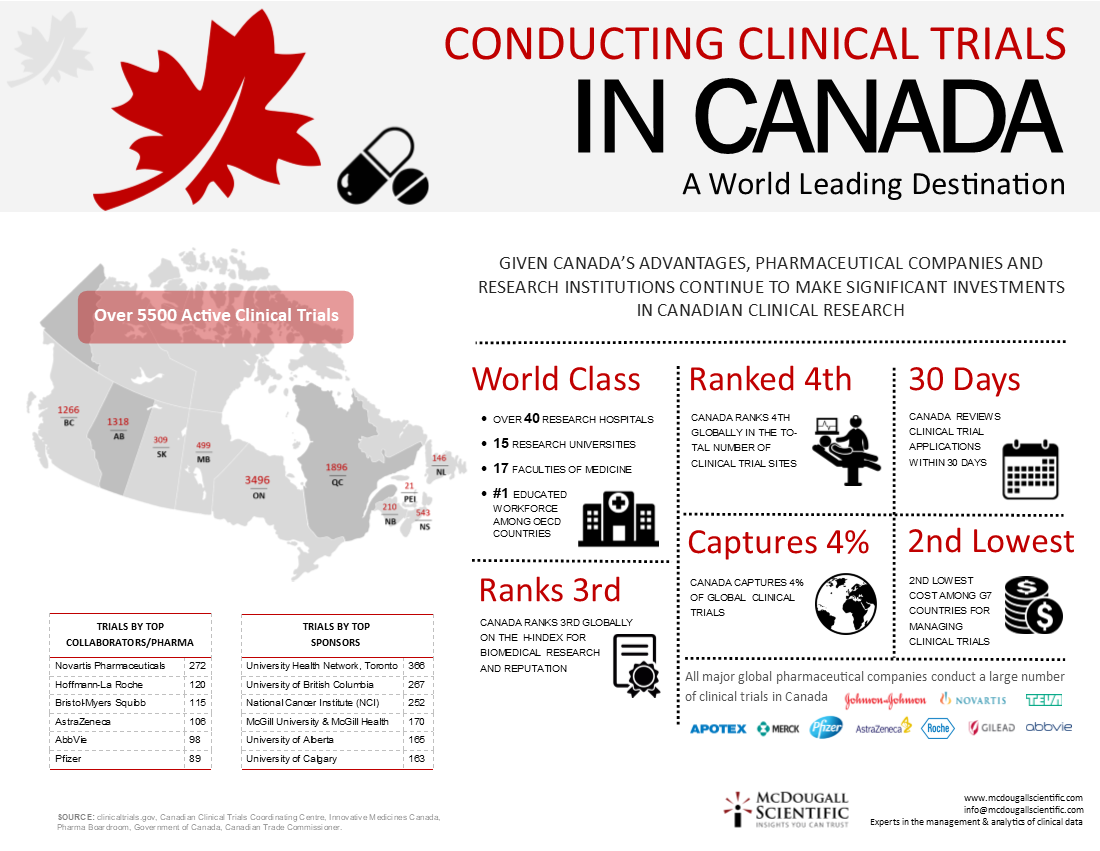
Canada now ranks fourth in the world for conduct of Clinical Trials

Fifteen to 20 years ago “Canada was the new kid” in clinical trials, but with 4.1% of clinical trial sites, Canada now ranks fourth in the world, after the United States (48.7%), Germany (5.7%) and France (4.3%), he said, citing data from a recent article on the globalization of clinical trials (Nature Reviews Drug Discov 2008;[7]:13-4).


Canadian-Clinical-Trials-Industry-Data-Infographic

This overview of the landscape of Canadian clinical trials, along with a historical primer (page 23), is the first in a series of articles CMAJ will present this year on the state of clinical trials in Canada and abroad. Many believe the system is in disarray because of spiralling costs and conflicting requirements. Among the issues that will be explored in upcoming articles are costs, recruitment, registration, ethical oversight, patient safety, reporting and the push for reforms.

Industry, government and academia will have to collaborate if Canada is to maintain or increase its share of clinical trials in the highly competitive global market, speakers told the fifth annual Clinical Trials in Canada conference.

“We think there is a crisis of clinical trials leaving Canada and there is fear that once they are gone they will be hard to get back,” said Ronald Heslegrave, chair of the ethics board at the University Health Network in Toronto, Ontario.

Compounding the problem is the difficulty in recruiting physicians to help run trials. “Few doctors in their 30s and 40s are interested in clinical trials or want to be trialists,” said Dr. Mary Bell, head of the rheumatology division at the Sunnybrook Health Sciences Centres in Toronto.

“We need to think about succession. We need to be more organized about training for subinvestigators,” while some current investigators need retraining, she told the conference, held Oct. 21 and 22 in Toronto.

Canada has experienced an increase in the number of phase I trials — a reflection of a Health Canada move to shorten the time to review these trials and a significant increase in spending worldwide at the phase I trial level. But the numbers of phase II and III trials have levelled or declined in the past few years.

“My sense is it would be a success just to maintain the current level of research and development,” commented Pierre Gervais, president of Q&T Research in Sherbrooke, Quebec.

Pharmaceutical companies are the main sponsors of clinical trials in Canada. In 2007, spending on clinical trials (close to $600 million) accounted for 78% of the companies’ applied research expenditures.

The vast majority (88.7%) of the companies’ research and development spending was in Ontario and Quebec, according to the Patented Medicines Prices Review Board’s 2007 annual report.

Pharmaceutical companies are increasingly outsourcing the running of clinical trials to contract research organizations, which organize trials both in the community and within hospitals.

Most phase I trials, however, are conducted by specialized contract research organizations, said Brett Wilson, an associate director of clinical site monitoring for Bristol-Myers Squibb Canada.

But the frontrunners are being challenged by the rapid expansion of capacity in countries such as Russia, Argentina, India, Hungary and China.

Canada’s clinical trials future will depend on cultivating the expertise to run smaller, more sophisticated trials, speakers from academic centres argued. “Trials looking at small effects and requiring large numbers of patients will not be done in Canada. … The focus will be targeted drugs producing bigger effects in smaller populations,” said Robert Phillips, deputy director of the Ontario Institute for Cancer Research.

Doctors and hospital-based researchers were urged to take a more business-like approach. “Investigators don’t think of themselves as business people. … But they are in business. They are not practising medicine when they are doing a trial,” said Margaret Kerr, a Toronto lawyer who specializes in contract work.

The meeting, organized by the private-sector group Insight Information, a division of Incisive Media, was attended by about 85 people, including the speakers and representatives from contract research organizations, brand-name pharmaceutical companies and government, as well as academic researchers and contract lawyers. It’s not often that such a diverse group meets, several participants noted.

Some of the many challenges facing the clinical trial industry identified at the meeting include:

  • A lack of basic information about the clinical trial landscape in Canada and a lack of cooperation among the various parties

  • The increased complexity of documentation required for clinical trials, lack of standardization in contracts and among research ethics boards, as well as other bureaucratic and administration complications

  • The public’s lack of confidence in pharmaceutical companies and difficulties recruiting patients for trials (with the exception of trials for cancer drugs)

  • Clinical trials that are unnecessarily complex and/or uninteresting to researchers, and the time and cost pressures resulting from drug firm financial realities.

Although pharmaceutical companies have increasingly outsourced the clinical trial business to contract research organizations, (these private sector organizations now run more clinical trials than universities or hospitals), the sector is “fragmented and diversified,” said Carl Viel, president of PÔLE, an agency established to promote economic development in the Québec City metropolitan area.

Indeed, when PÔLE set out to map the presence and activities of contract research organizations in the Québec City area, it had to hire a student for the task because the province could provide no information, Viel told the conference.

Meanwhile, little is known about where the organizations operate, because many are involved with running trials offshore. “Canadian companies have created thousands of jobs internationally.”

Gervais said that government representatives have no idea about how much research is done in the private sector, “there is no structure to welcome more,” and governments seem to deem the sector too small to warrant tracking.

Meanwhile, the academic clinical trial sector suffers from a similar lack of cooperation and information, speakers told the conference. Many Canadian hospitals and research institutions are aiming to improve their capacity to run clinical trials, and academic researchers are establishing and strengthening clinical trial specialty groups involving multiple sites.

But cooperation among hospitals “is the exception rather than the rule,” said Phillips. Clinical trials are “grafted onto other hospital practices,” he said, noting that when he offered to help design model systems for clinical trials, hospitals “were so burdened with patient care” that they couldn’t spare the time to work with him.

And within hospitals, individual site groups are “often autonomous empires with little oversight,” Phillips added. When his institute established a database (www.ontariocancertrials.ca) of clinical trials “we thought it was for patients, but nurses use it to find out about trials in their own hospitals.”

The current system typically works for well-known senior clinician scientists, who are sought out to conduct trials, but it can be hard for young scientists to get a foot in the door, he added.

Meanwhile, variations in contract language and in the requirements of research ethics boards pose problems for both hospitals and research institutes, speakers told the conference. The push to standardize contracts and to harmonize research ethics board approval standards is making slow progress.

The University of Toronto system has developed a template contract, and St. Michael’s Hospital often settles on contract language with the sponsoring pharmaceutical company, said Michelle Moldofsky, a policy and legal adviser with the hospital’s office of research administration.

But contract research organizations are “adding another party to the mix” and they “very rarely” agree on the sponsor’s template, she said.

For Canada-wide trials, organizers must cope with differing provincial privacy legislation, and the increase in the number of foreign-sponsored trials is accompanied by language, cultural and legal challenges, she said.

“With the globalization of research, we have to reach through layers and layers of people,” added Kerr. “We need a Batphone to the commissioner.”

Foreign sponsors have also had some difficulty with the fact that Canadian physicians are not site employees but rather independent contractors, which affects the insurance provisions of contracts, the lawyer said.

For the Canadian subsidiaries of international pharmaceutical companies, difficulties can arise when trials are set by global colleagues so that subsidiaries are limited in their ability to influence contracts or protocols, several speakers said.

Kerr said another stumbling block for some sponsors is the University of Toronto’s requirement that clinical trial sites report any adverse events suffered by patients to both Health Canada and the research ethics boards of other sites involved in a multisite trial.

Those adverse events may be becoming more common because of time pressures, suggested Janice Parente, president of ethica Clinical Research Inc. of Montreal, Quebec. Drugs are being withdrawn from the market because “the research was not done properly. … Maybe we need to relax the time,” she said. “We are making huge mistakes that affect humans.”

Heslegrave said that in protocol violations involving patients — for example, a pregnancy test not being undertaken on a trial participant — the excuse typically offered is that “there is no time.”

Only 1%–3% of the eligible Canadian population participates in clinical trials, Wilson said. Speakers blamed the difficulty in recruiting patients (except for cancer patients) on widespread publicity about drug withdrawals, as well as a shift in the public’s perception of drug companies — from discoverers of new medications to commodity providers.

This change in perception is likely fuelled by widespread direct-to-consumer advertising of prescription drugs (illegal in Canada but familiar to Canadians through United States television and magazines), said Murray Jensen, director of clinical and scientific affairs for ethica.

On the other hand, Pierre Geoffroy, a senior director with sanofi pasteur, suggested public confidence may have been undermined because advances in pharmacovigilance and post-market surveillance of drugs are leading to publicity about “post-market misadventures” that may have gone unidentified in the past.

To attract more doctors to clinical trials, the administrative burden on them must be lifted, said Wilson.

But part of the difficulty in recruiting physicians lies in the trials themselves, argued Muhammad Mamdani, director of the Applied Health Research Centre at the Li Ka Shing Knowledge Institute in Toronto. “I can’t tell you the number of industry trials which are of no interest to doctors,” he said.

Mamdani said the unnecessary complexity of trials is another stumbling block.

Heslegrave concurs. “At the REB [research ethic board] level, we see increasingly complex studies that try to do too much, that have one primary and lots of secondary objectives, and are not powered enough, so questions arise if these are even valid studies.”

For Canada to “survive and prosper” with clinical trials, there must be more early cooperation on study design between academics and the pharmaceutical companies sponsoring the trials, and multicentre trials must be easier to initiate, said Phillips. “Companies can’t just come to a CRO [contract research organization] and say, ‚here it is, do it’.”

In the future, clinical trials should answer not just whether or not a drug works for a specific population, but why, Phillips added. “Drugs should be based on science, not serendipity. The goal will be to design drugs targeted to patients and we need to recognize this change.”

If contract research organizations want to be involved in high-impact clinical trials, they will have to build links with the academics, Phillips later said in an interview. “Everyone is groping with how to come to a mechanism to bring teams together.”


“The market is booming…the volume of products reaching clinical phase, is unprecedented”

Becky Carpenter, Head of North America/Euro Operations at WuXi Clinical, recently answered questions from Applied Clinical Trials about the evolution of the mid-sized pharma and CRO space. WuXi Clinical is a new mid-sized CRO resulting from the merger of Research Point Global and WuXi Clinical Development Services (CDS.) The rebranding is being launched at this week’s DIA 2019 in San Diego. The newly combined company employs about 1,000 clinical research specialists across 20 global locations with two main hubs in the US and China.


D-kH1PjXUAAjKw6

ACT: What are some of the most significant changes in the mid-tier pharma market you’ve observed over the last five years and how is that translating to impacts on CROs?

BC: One major difference is that the mid-to-larger CROs are all now realizing the huge potential of small to mid-size sponsor companies—it’s a natural evolution of how the pipeline is changing, with many discoveries coming from small and more diverse companies. So even the larger CROs are now attempting to create operating units designed to serve the smaller client. The crucial point of course, is that not everyone is really capable of understanding their unique needs and expectations. The level of support needed for some of the smaller and more nimble customers, the big CROs are not set up to service. Becky Carpenter Understandably, that means a big opportunity for companies like ourselves operating just below the traditional big six or seven CROs.

ACT: How do you anticipate the CRO market will look like in five years’ time? What role will WuXi Clinical play?

BC: The good news is, the market is booming, everyone is busy. The volume of products reaching clinical phase, especially in the oncology space, is unprecedented. Across all sectors, there are more than 300,000 trials and more than 100,000 in the US.What we are also seeing in the last few years is that China has established itself as a leader in discovery, as a result of the number of life science professionals and the abundance of capital available for innovators. CROs that are poised to serve this market will undoubtedly grow in the coming years. So in five years’ time we will be looking at a market still with huge number of products emerging into trials from the US, but also, a significantly large number from China.

ACT: Can you describe what typical mid-sized customers need from their CRO partners? What challenges do they face?

BC: It is one thing to set up bespoke divisions for smaller customers, but quite another to be providing them with the specialist services they need. With our clients, it’s very much a partnership and we bring in senior trial expertise to oversee work, as we understand that, unlike in big pharma, much of this experience is coming from our team. The other aspect is that these customers are far nimbler in their operations and they need us to be able to have the same level of flexibility, and, crucially, responsiveness. For the smaller companies, the limited number of products they have in development are quite often critical to the company’s overall survival and success. It’s not one of a portfolio, but their number one priority. That is what a good CRO partner recognizes and we try to act as a natural extension of in-house teams, working cross-functionally. We work together to reach milestones. On a more practical level, a larger CRO might not have the incentive to prioritize a smaller client’s needs and instead will seek to give preferential access to larger partners. The CRO partner chosen needs to be able to fight in their client’s corner—for instance, site access can often be very competitive.

ACT: How will the company balance any future expansion (remaining in the mid-size space, i.e., not too big, but also continuing to extend service offerings, etc.)?

BC: It is a good question, but undoubtedly, our biggest asset is and will continue to be our people, and we retain our best talent with the core founders still within the business. It’s also a matter of company culture, and we have been very clear in that we aim to be the best—not the biggest. What we intend to do from here is supplement what we have been doing well for more than 20 years—flexible client-centric services—with the new capabilities we can offer. We have hundreds of repeat customers, and we can now help them through the wider WuXi Group to achieve full development of their products, and without having to change providers. There are also obvious synergies for many of our clients in the new opportunities in China. In everything we do, we look for how we can better enable our clients; we really see them as our partners, and we will look to grow together.

ACT: How do the needs of US customers differ from the needs of those in China?

BC: In terms of markets, the US customer, understandably, looks first at incorporating the US markets and then Europe and increasingly Asia. But in China, the focus will either be domestic first or increasingly US and China in parallel. For our US customers, what they value most is our expertise and the quality of the trial put in place. It has been something of great pride that this year we improved “enrollment goal completion” ahead of time to 92 percent. This also resonates very positively in China, as clients here are very aggressive in the timelines they set, and they value CROs that are able help them complete ahead of their competitors.

ACT: How important is flexibility? It is often cited as a key element for biotechs and medium-sized pharma.

BC: It is probably the single-most important factor for them, along with expertise. Biotechs and mid-sized pharma need a partner they can trust to be there when they need them, and be flexible in delivery—from changing timelines to recruiting complex subject populations. It very much what sets a great CRO apart from a merely good one. Can they deliver to changing needs, for example, the ability to train staff very quickly to monitor for even the most complicated indications?

Sponsors Need Vendors’ Metrics to Select the Best

An issue causing growing frustration among clinical trial executives are vendors unable or unwilling to share metrics with sponsors.

images

While careful vendor selection is more critical than ever because of ICH E6, sponsors are increasingly frustrated with a lack of metrics to help gauge how likely it is that an operational problem may arise with a vendor.

“You need information to be able to help you understand what has happened in the past, how often has it happened, how bad the impact is when it does happen,” says Linda Sullivan, co-founder and executive director of Metrics Champion Consortium (MCC).

Many vendors have standard reports to measure what they consider key performance indicators, and sponsors should review those reports and determine if they meet the trial’s needs. But sponsors and CROs need to share information with vendors too.

“I think where people run into problems is when they don’t share enough information with the vendors about what’s going to happen in their program,” says Sullivan. “Often, problems in the design of the study could be avoided if vendors were brought in earlier.”

Problems with certain types of vendors can be more critical than others, according to Jill Petro, a trial manager at Janssen R&D.

Although translation, laboratory and interactive voice/web response vendors comprise a small portion of the overall clinical research enterprise, mistakes in those areas can cause critical delays, Petro says, so it’s important to be particularly vigilant.

“It’s easy to say you’re trying to pick for the best quality,” she says, “but there are a lot of things that feed into quality.” Petro recommends using a checklist to make sure all considerations are covered.

For translation vendors specifically, Petro advises asking what portion of the staff is full-time (to gauge the likelihood of high turnover), and about the minimum training requirements for staff (to gauge the likelihood of errors).

Another important component is the vendor’s internal quality standards, such as requiring double-checks for each document, and whether those additional quality checks come at an extra charge. Finally, it’s best to ask about the vendor’s policy on a rush turnaround, in case of a protocol change later down the line.

For central laboratories, Petro recommends asking about such factors as the lab’s ability to perform all of the tests the trial requires, how long it takes to ship kits to sites and how quickly it can deliver results. She also advises asking about the company’s ability to transfer data to the sponsor and whether there is an additional charge for doing do.

Finally, for interactive voice services, sponsors should be aware of the vendor’s experience with the type of trial being conducted, such as a randomization v. stratification trial design. Like the other vendors, the vendor should be able to transfer data and should be comfortable with the various countries/languages included in the study.

“It all comes back to that risk base and oversight” outlined in ICH E6, Petro says. “Every company is looking for technology solutions [to] be able to tell FDA inspectors that they are doing their oversight.”

Another Biotech Plant Explosion in China Kills Six

Six people were killed in an explosion in a biotech plant in central China last Wednesday.

The explosion, which is still being investigated, happened at Xumei Biotech Co. Ltd. in Weishi County, part of China’s Henan Province. Five people were killed instantly and another died at the hospital, China’s news agency Xinhua said. Additionally, five other people are receiving medical treatment at the local hospital. One of those patients is in critical condition, Xinhua reported.

According to a report from Beijing News, a double-deck tank exploded Wednesday night and trapped the six people in a workshop at Xumei Biotech. By the time the fire from the explosion had been put out by first responders, five employees had expired. The sixth was in critical condition and died later at the hospital.

The head of the company had been detained by authorities as part of the investigation. It is unclear if the detention was a routine part of the investigative procedure in that country or if he was suspected of malfeasance of some kind.

51a4f5b8-f54b-436a-b380-848d5d54b03b

This is not the first biotech workplace explosion that has caused death or injury of employees. Earlier this month, two Chinese nationals were killed in an explosion at a Puslin Biotechnologies facility in India. The two Chinese employees, along with an Indian employee, were repairing an oven used to dry the company’s products when the explosion occurred, in-Pharmatechnologist reported. The chief product developed by Puslin is used to improve joint function and slow the progression of osteoarthritis.

In April, 10 people were killed and about a dozen were injured in an explosion at Qilu Tianhe Huishi Pharmaceuticals in China. Qilu Tianhe Huishi Pharmaceuticals is a generic drugmaker. The explosion resulted due to maintenance work being conducted on underground piping, in-Pharmatechnologist reported, citing Chinese news agencies. The pipe was being welded and the heat from the process ignited gas, which caused the explosion.

In March, a chemical plant explosion in China killed 62 people. That explosion created some ripple effects in the pharmaceutical ingredients supply chain for Swiss-based Lonza. Sales stagnated as a result. According to Reuters, the company “blamed raw material shortages and supply-chain disruptions from the March 21 chemical plant explosion.”

In 2015, a GlaxoSmithKline plant in China was rocked by explosions that took the lives of 165 people, according to Reuters. Months later, the Tianjin facility was rocked by a different kind of explosion. The European Medicines Agency recommended that products from that facility be banned from Europe until the factory was able to deal with long-term manufacturing problems. Prior to the August 2015 explosions, regulators from Europe found a “critical deficiency” tied to the manufacturing process. That deficiency raised questions as to whether or not the drugs developed at the site were fit for market.

Following reports of a series of explosions at a chemical factory in China, the world’s largest chemical supplying country, Reuters reported that China’s “breakneck pace of economic growthduring the last decade has resulted in a spate of industrial accidents.”

GR-CIS supporting Big Innovation (BI) 2020

Global Regulatory & Consumer Insights (GR-CIS) always encouraged young generation to ideate and innovate for the better healthcare outcomes of the society.

Mr. Tarun Pandotra (Founder-GR-CIS) is now part of Big Innovation 2020 as Advisor and Judge.

IMG_7476

Big Innovation (BI) is a pioneering initiative by Whites Science Innovation Limited, UK & LexGin (IPR facilitator). BI is an All India Pharmaceutical & Healthcare Innovation & Entrepreneurship Contest with a vision to “provide a national platform and bringing out the Innovation & Entrepreneurship talent the Youth to help provide better healthcare to our future generations”.

The program’s motto ‘Bring Innovation Culture’ essentially summarise our continuous efforts to enable an ecosystem where students from across the country feel free to ideate and innovate for the better healthcare outcomes of the society and help them incubate start-ups to become job creators.

The contest’s uniqueness lies in the fact that it is one-of-its-kind initiative in its category that exclusively focuses on healthcare technological innovations at a national level and supports the entrepreneurs. BI initiative identifies, mentors, and financially supports health-tech innovations across India in the thematic area of Healthcare.

http://biginnovation.in/judges/

Visit Us On TwitterVisit Us On Google PlusVisit Us On LinkedinVisit Us On Facebook